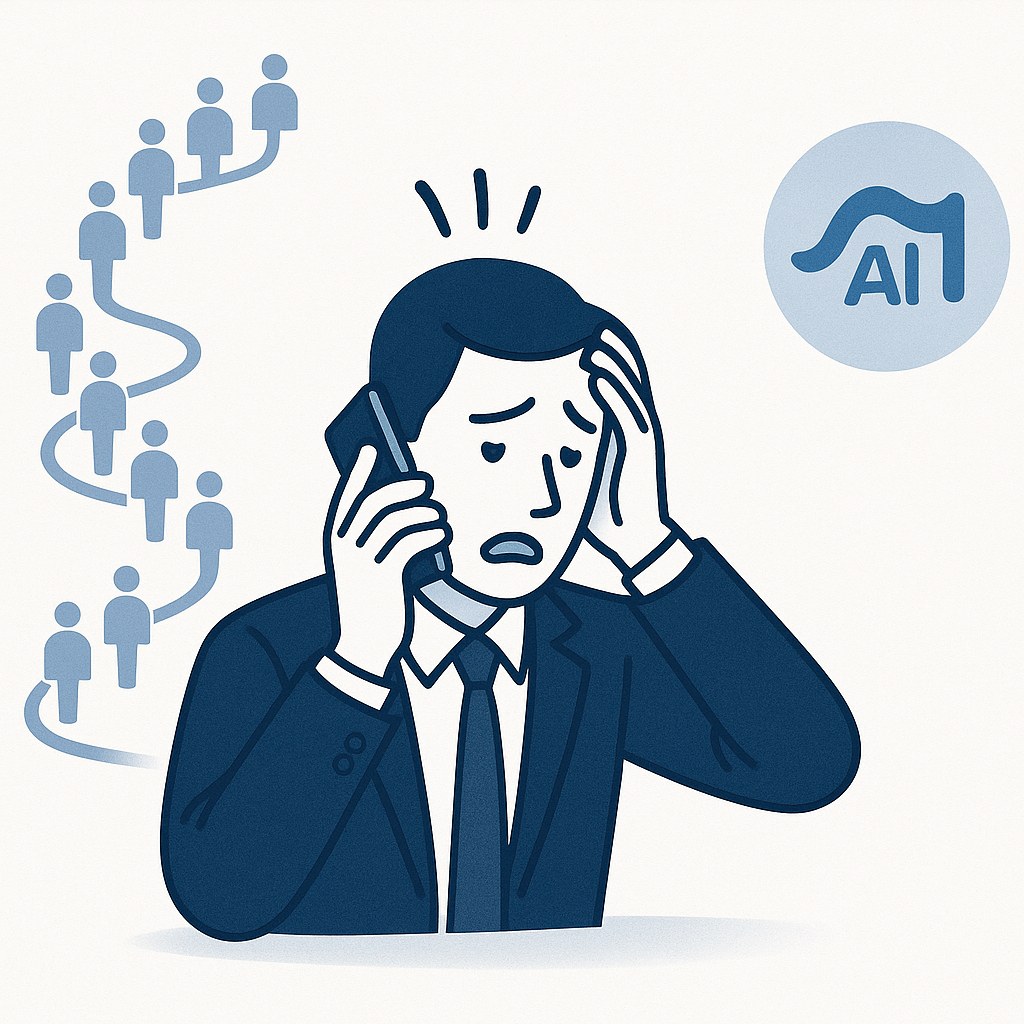
The Psychology Behind Why Customers Hate Being Put on Hold
Customers hate hold time psychology is a real, documented phenomenon — and if you run a small business, you're probably losing customers because of it right now. I'm not being dramatic. The frustration people feel when they're stuck listening to elevator music isn't just mild annoyance. It's a deep, visceral reaction rooted in how the human brain processes waiting, uncertainty, and perceived disrespect. Understanding why customers feel this way changed how I built CallagentAI from the ground up.
So let's talk about what's actually happening inside your customer's head when they hit that hold button.
It's Not About the Wait — It's About Control
Here's the thing most business owners get wrong: customers don't hate waiting because they're impatient. They hate it because they've lost control.
Psychologists call this "perceived control" — and it's one of the strongest predictors of human stress. When someone dials your business and gets put on hold, they can't hang up without losing their place in line. They can't do anything productive without risking missing the agent. They're just... stuck. Hostage to your queue.
Think about the last time you waited in a doctor's waiting room where they told you "it'll be about 10 minutes." That 10-minute wait felt completely different from the times they said nothing at all, right? Same duration. Totally different emotional experience. That's hold time psychology in action.
When a customer calls your HVAC company at 7pm because their furnace died and gets dropped into a hold queue with no estimated wait time and no options, they're not just frustrated — their stress response is literally activated. Cortisol spikes. Patience evaporates. And that feeling gets permanently associated with your brand.
The Psychology of Hold Time — Why It Hits So Hard
Customers hate hold time psychology for several overlapping psychological reasons, and they stack on top of each other fast. Here's what's happening neurologically:
1. Unoccupied time feels longer than occupied time
This is one of the most well-replicated findings in time perception research. When your brain has nothing to do, it monitors the clock obsessively. A 3-minute wait on hold feels like 8 minutes. Research from Harvard Business School has shown that uncertain waits feel 36% longer than known waits of the exact same duration. That hold music isn't filling time — it's amplifying the misery.
2. The "sunk cost" trap kicks in
Once someone has waited 2 minutes, they feel psychologically committed. Hanging up now means "wasting" those 2 minutes. So they stay. And their resentment builds. By the time your agent finally picks up, the customer is already primed for a bad interaction — no matter how friendly your rep is.
3. It signals low status
Honestly, this one surprised me when I first read about it. Being put on hold communicates — subconsciously — that your time is worth less than the company's time. It's a status signal. And humans are wired to be acutely sensitive to status dynamics. Nobody likes feeling like an afterthought, especially when they're about to give you money.
4. Uncertainty is more stressful than bad news
This is wild but true. Studies show people prefer knowing something negative is definitely coming over not knowing what will happen. Uncertainty activates the brain's threat-detection system continuously. "Your call is important to us" on a loop doesn't reduce that uncertainty — it actually makes it worse because you're clearly being lied to.
What the Data Says About Hold Time Psychology and Customer Loyalty
The customers hate hold time psychology problem isn't just a feelings issue. It has hard financial consequences that show up in your revenue.
- 62% of calls to small businesses go unanswered entirely — and most of those callers never call back.
- The average small business loses an estimated $75,000 per year from missed and mishandled calls.
- According to customer experience surveys, 60% of customers will hang up after being on hold for 1 minute — and many of them won't call back at all.
- A significant portion of customers who hang up immediately search for a competitor. Not tomorrow. Right then, while they're still annoyed.
Real talk: I've talked to hundreds of small business owners since building CallagentAI, and the pattern I see over and over is the same. A dental office in Phoenix loses 4-5 new patient inquiries every week because calls come in during patient hours and nobody can answer. A law firm in Atlanta estimates they're missing 2-3 qualified leads every single day after 5pm. None of these business owners thought the hold problem was costing them that much — until they ran the numbers.
Understanding customers hate hold time psychology isn't an abstract exercise. It directly maps to dollars walking out the door.
The Hidden Cost Most Business Owners Ignore
Beyond the immediate hang-up, hold time psychology creates a compounding loyalty problem. Here's what I mean.
When a customer has a bad hold experience, they don't just leave that interaction frustrated. They remember it. The next time they need to call you, that memory shapes their expectation before the phone even rings. Some won't bother calling at all — they'll go straight to a competitor who made it easier. Others will call, but they'll be primed for irritation from the first second.
And then there's the social multiplier. One frustrated customer talks to an average of 9-15 people about a bad experience. That negative word-of-mouth doesn't show up as a Google review you can respond to — it's just quiet erosion of your reputation, one conversation at a time.
The good news? This works in reverse too. When customers reach someone immediately, feel heard, and get their question answered without waiting — they tell people about that too. A real estate agent I spoke to recently told me her clients regularly comment on how quickly they got a response when they called after-hours. That's become part of how she pitches her service level to new prospects.
How to Fix the Hold Time Problem for Good
So we've established why customers hate hold time psychology is a legitimate business threat. What actually fixes it?
The traditional answers — hire more staff, use an answering service, set up a better IVR — all have serious problems. More staff is expensive and doesn't solve after-hours coverage. Traditional answering services charge $3,000-$4,000 per month for a human receptionist. And a clunky IVR system just makes the hold time psychology problem worse by adding friction before the wait even starts.
What actually works is removing the hold time entirely.
That's the core philosophy behind what I built at CallagentAI. Instead of making callers wait, an AI voice agent picks up in under one second — any time of day, any volume of calls. There's no queue. No music. No "your call is important to us." Just an immediate, natural-sounding conversation that answers questions, books appointments, captures lead information, and transfers to a human when needed.
The psychological shift for callers is immediate. They feel heard. They feel like your business is responsive and professional. And that feeling — that first impression — is worth far more than the cost of the technology creating it.
Check out the full features page if you want to see exactly how the AI handles different types of calls. The short version: it books appointments via Cal.com, captures leads, sends SMS follow-ups, and handles FAQs — all without anyone sitting at a phone waiting for it to ring.
The pricing is also genuinely accessible compared to the alternatives. We're talking 90% less than a human receptionist — and unlike a human, it's available at 3am on Christmas morning.
For businesses already running a website, the WordPress plugin adds a voice widget directly to your site so visitors can call or chat without even picking up their phone. That's another touchpoint where customers hate hold time psychology is completely bypassed — because there is no hold.
What This Looks Like in Practice
A plumbing company in Ohio started using CallagentAI to handle after-hours calls. Within the first month, they captured 14 service requests that would have gone to voicemail — and likely to a competitor — between 6pm and 8am. At an average job value of $400, that's over $5,600 in one month from calls that used to disappear into the void.
That's what happens when you take customers hate hold time psychology seriously and actually do something about it.
The Bottom Line
Customers hate hold time psychology isn't just interesting neuroscience trivia. It's a window into one of the most preventable revenue leaks in small business. The brain's response to waiting, uncertainty, and loss of control is deeply wired — and no amount of better hold music or friendlier scripts changes that fundamental equation.
The businesses winning on customer experience right now aren't the ones with the nicest hold messages. They're the ones who've eliminated hold time altogether — because they understand that every second a customer waits is a second they're reconsidering their choice to call you in the first place.
If you want to see what it actually feels like to have a call answered instantly by AI, try the demo. It takes about 60 seconds and it'll give you a much better sense of what your customers would experience than any description I can write here.
The psychology is working against you every time a call goes on hold. The question is whether you're going to let it keep costing you customers — or do something about it.