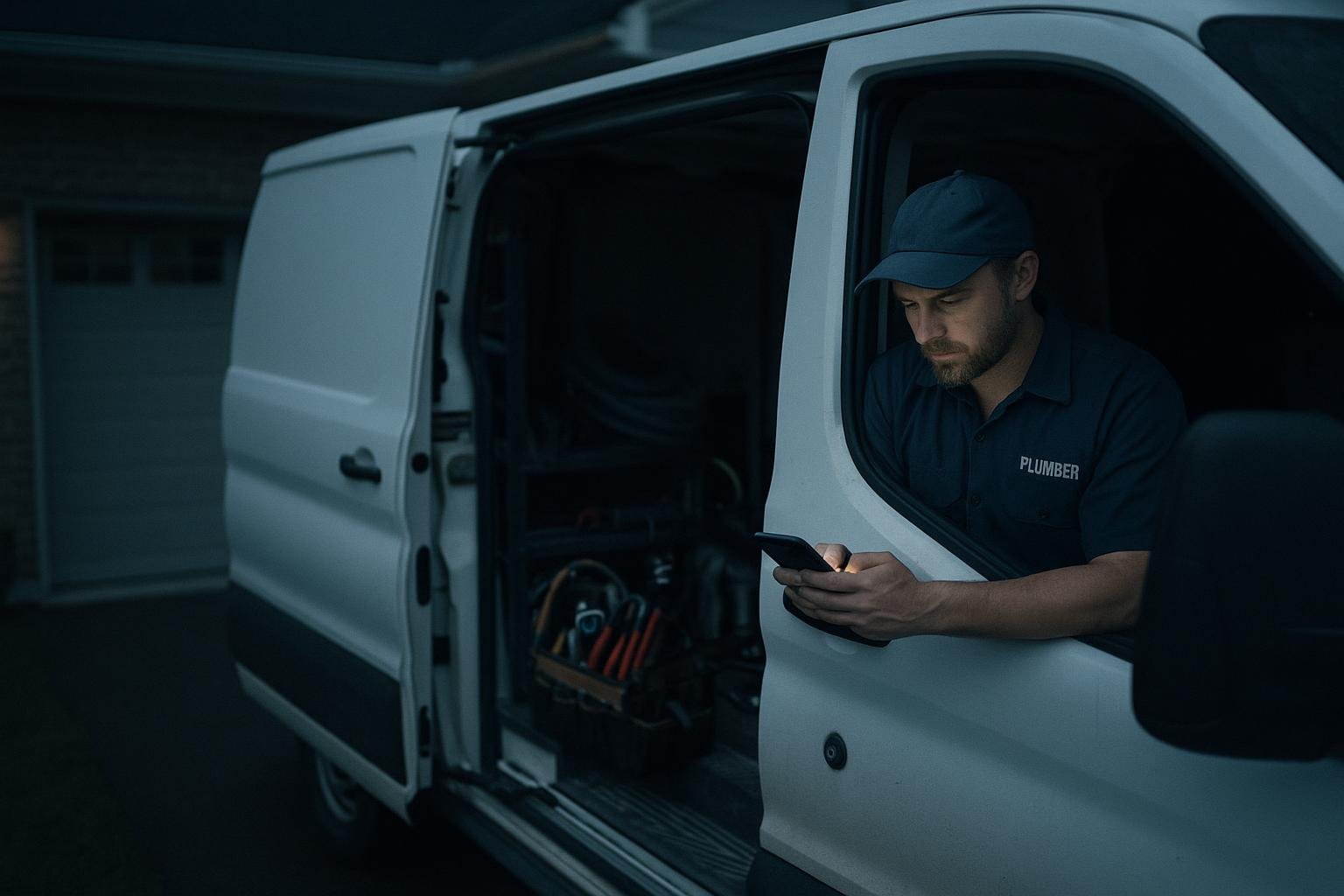
The $15K Mistake: What Happens When Your Plumbing Business Doesn't Answer
A plumbing answering service is a 24/7 AI-powered call handling system that answers every inbound call, qualifies the urgency, captures the caller's details, and books the job — so plumbing businesses never lose a customer to voicemail, especially during peak season emergencies when every missed call triggers a cascade of lost referrals.
- One missed emergency call can eliminate an entire referral chain worth thousands of dollars.
- 62% of calls to small businesses go unanswered — plumbing shops are hit hardest during surge seasons.
- A 24/7 AI answering service costs roughly $300–500/month versus $3,000–4,000/month for a human receptionist.
- The damage isn't the lost job — it's the one-star review and the five neighbors who never call you.
The Moment It Happens
It's 11:40 PM on a Tuesday in March. The ground's still frozen, pipes are stressed, and a homeowner in your service area just heard a sound behind their wall that no homeowner ever wants to hear. They grab their phone and search for an emergency plumber. They find your number. They call.
Your phone rings four times. Voicemail picks up.
They hang up and call the next result on Google. That plumber answers. Books the job. Shows up at midnight, fixes the burst pipe, and hands the homeowner a card. Two weeks later, that same homeowner recommends them at a neighborhood cookout. Then at a school pickup. Then in the local Facebook group where 3,400 people ask for contractor recommendations every single month.
You never knew any of this happened. You were on a job site, your tech was on another call, and your phone went to voicemail. That's the whole story. Simple, quiet, and brutally expensive.
The Real Cost of a Missed Call
Here's where most people undercount it. They think about the one job — call it $800 to $1,200 for an emergency service call. That stings, but it's survivable. The real number is bigger.
Think about the referral chain that homeowner would have generated over the next three to five years. Emergency plumbing customers who have a good experience don't just leave. They tell people. They become the person in their neighborhood who "knows a great plumber." Each one of those referrals is worth another job. Add those up — new installs, water heater replacements, full bathroom remodels — and a single emergency call can easily represent $10,000 to $15,000 in lifetime customer value before you account for the word-of-mouth ripple.
And then there's the review. An angry customer who couldn't reach you during an emergency doesn't usually stay quiet. Research consistently shows that dissatisfied customers are far more likely to share their experience than satisfied ones. A one-star review mentioning "couldn't reach them when my pipe burst" does lasting damage to your Google Business profile — which is, for most residential plumbers, the single most important lead source they have.
One missed call. One furious customer. One bad review. Five neighbors who never call you. That's how $15,000 disappears without a single invoice to show for it.
Why Calls Keep Getting Missed
I talk to plumbing business owners all the time, and they all know this problem exists. None of them want to miss calls. So why does it keep happening?
The mechanism is usually one of three things. First: you're a working owner or a small crew, and when everyone's on a job, nobody's watching the phone. Second: you have office staff, but they work 8 to 5, and emergencies don't. Third: you've got a voicemail system that was fine when you were doing ten calls a week, but now call volume spikes every spring thaw and every deep freeze, and the system just can't keep up.
Spring and fall are the worst. Pipe thaws in March, sump pump failures in April, water heater failures when the temperature swings hard — that's when call volume doubles and your capacity doesn't. Callers in an emergency have zero patience for voicemail. They hang up and dial the next result inside thirty seconds. Your competitor doesn't have to be better than you. They just have to pick up.
This is the gap a plumbing answering service closes. Not by adding staff. By making sure the phone is always answered, always qualified, always handed off — without anyone having to be at a desk.
What a Plumbing Answering Service Actually Does for Your Business
A good plumbing answering service does four things on every call, in order.
First, it answers. Under one second. No rings, no hold music, no voicemail greeting. The caller hears a real voice — natural, conversational, trained on your business — immediately. That first second matters more than people realize. An emergency caller who hears an immediate answer doesn't hang up.
Second, it qualifies. Is this a burst pipe with water actively running? A slow drain that can wait until Tuesday? A water heater that went out but the family has somewhere to stay tonight? The AI asks the right questions, grades the urgency in real time, and captures the details — caller name, address, problem description, how urgent, whether they've shut off the main. Structured data, not a voicemail someone has to transcribe at 7 AM.
Third, it hands off. The call produces a structured summary that gets pushed out immediately — through a webhook into whatever system you're already running. If you're routing jobs through a tool like Jobber or ServiceTitan, you can wire that webhook through Zapier or Make and have the job details land in your system without anyone retyping them. No delay, no data entry, no "I thought I sent that to you." You can see the full integrations available here, including native support for Zoho CRM and Cal.com booking.
Fourth, it closes the loop. After every call, the customer gets an automatic text and email recap — what was captured, what happens next, when to expect contact. That confirmation is more important than most people give it credit for. An emergency caller who gets a text at midnight saying "We've received your request, a tech will contact you within the hour" is a different emotional experience than silence. They stay. They don't call your competitor as a backup. And when you do show up, they're already predisposed to trust you.
How Does a Plumbing Answering Service Work?
The setup is simpler than most business owners expect. You point your existing business number — or a new one — to the AI agent. You give it your business info: service area, hours, emergency vs. routine procedures, what questions to ask, how to greet callers. It takes about ten minutes to configure. No new hardware, no technical team required.
From the caller's side, it sounds like talking to a knowledgeable person on your staff. The AI handles the full conversation — including pushback, follow-up questions, and callers who want to vent — and routes only the calls that genuinely need a human to your cell or your dispatcher's line. Everything else is captured, documented, and handled.
You can check the full feature set yourself, but the short version is: 24/7 answering, real-time call transcripts, call recording, automatic SMS and email follow-up, appointment booking via Cal.com, and lead capture with every field you need to dispatch a tech.
Before and After: The Numbers Side-by-Side
| Situation | Without an Answering Service | With a Plumbing Answering Service |
|---|---|---|
| 11 PM emergency call | Voicemail. Caller hangs up in 30 seconds. | Answered in <1 second. Urgency qualified. Details captured. |
| Peak season call surge | Lines overwhelmed. Callers go to competitors. | Unlimited concurrent calls. Every caller reaches someone. |
| Job handoff to dispatcher | Voicemail transcribed manually next morning. | Structured data pushed via webhook immediately. |
| Customer confirmation | Silence. Customer calls competitor as backup. | Automatic text + email recap sent within minutes. |
| Monthly cost | $3,000–4,000/month for a human receptionist | $300–500/month for AI, per BLS salary data comparison |
That cost gap is real. A full-time receptionist runs $30,000 to $60,000 a year in salary alone, before benefits. An AI plumbing answering service runs a fraction of that — and it's available at 2 AM on Christmas Eve without overtime.
Why It Holds Up in the Real World
The objection I hear most from plumbing owners is some version of "my customers want to talk to a real person." And I get it. But here's what actually happens in an emergency: the customer wants to feel heard, fast. They want to know someone received their problem and something is happening. An AI that answers in under a second, asks the right questions, and sends a confirmation text delivers that experience better than a phone ringing into voicemail ever could.
The second objection is about the tech. "We already run a bunch of systems, I don't want to add another one." Completely fair. The point of a plumbing answering service isn't to replace your dispatch workflow — it's to feed it. The call data comes out as structured fields. You route it by webhook into whatever you're already using. If your system has a Zapier connector, your team gets a job record without touching it. Nothing replaces. Nothing changes except that the phone is always answered.
Honestly, the business owners I've seen get the most out of this are the ones who were already losing jobs they didn't know about. They set it up, look at the call dashboard a week later, and realize how many calls they were missing at 7 AM before the office opened, or at 6 PM after everyone left. That visibility alone changes how they run the business.
If you want to see exactly how this works before committing, the demo page has a live walkthrough. No sales call required — you can hear the AI handle a plumbing emergency call yourself and decide from there.
Frequently Asked Questions
What is a plumbing answering service and how is it different from voicemail?
A plumbing answering service is a live or AI-powered system that answers every inbound call in real time, qualifies the issue, and captures the caller's details — unlike voicemail, which records a message that may not be heard for hours. During a pipe emergency, that difference means the customer stays with you instead of calling your competitor.
How much does a plumbing answering service cost?
An AI-powered plumbing answering service typically costs $300–500 per month, compared to $3,000–4,000 per month for a human receptionist. That's roughly a 90% cost reduction for equivalent or better availability — including nights, weekends, and holiday call surges that human staff cannot cover without significant overtime.
Will my customers know they're talking to an AI?
Modern AI voice agents sound natural and conversational. Most callers focus on whether their problem is being heard and handled quickly — not on who or what is doing the listening. In an emergency, a calm, immediate answer that captures the right information and confirms next steps matters far more than whether the voice belongs to a human or an AI.
Can the answering service handle peak season call spikes?
Yes. An AI plumbing answering service handles unlimited concurrent calls — there's no busy signal, no overflow, no queue. During spring thaws or deep freezes when call volume doubles, every caller reaches someone immediately. This is the core advantage over both voicemail and a single human receptionist who can only manage one call at a time.
How does the job information get to my dispatcher?
After each call, structured data — caller name, address, problem description, urgency level — is pushed out via webhook. If you run a field service tool with a Zapier connector, you can wire that data in automatically without anyone retyping it. Your dispatcher sees the job details immediately rather than waiting for someone to transcribe a voicemail the next morning.
Does a plumbing answering service work after hours and on weekends?
That's exactly when it matters most. A plumbing answering service runs 24/7/365 — no holidays, no sick days, no missed calls because a tech forgot to forward the line. Emergency plumbing calls peak at night and on weekends. Having a system that answers those calls consistently is the difference between being the plumber people recommend and the one they gave up on.