
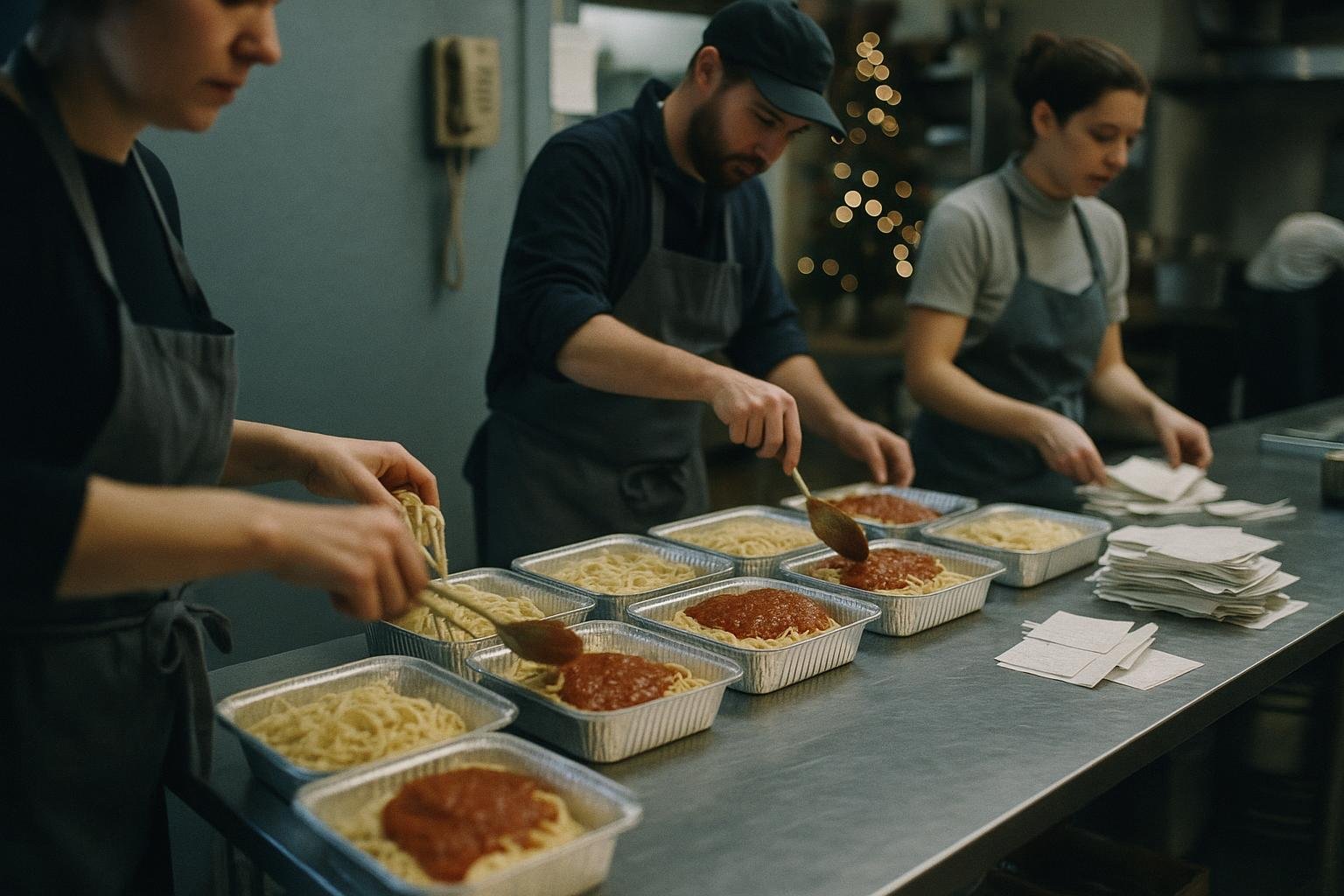
Catering Phone Orders: How Palma Pasta Handles the Holiday Rush
Catering phone orders are the lifeblood of a food business like Palma Pasta, and they arrive in floods, weeks before Christmas, Easter and Thanksgiving. Since spring 2025, an AI agent from Call Agent AI has answered those calls, taken the orders, and sent them straight into Palma Pasta's online store. Over 3,000 calls later, here's what that looks like, in real numbers and in their owner's own words.
- Just over 3,000 calls logged on Palma Pasta's lines since April 2025, averaging about two minutes each.
- About one call in six came in before 9am, after 5pm, or on a weekend.
- The busiest month was March 2026, with 775 calls in the run-up to Easter.
- Roughly 500 calls were handed to a staff member when a person was the right answer.
- The owner's summary: "you're not having to hire that extra person."
"The phone rings off the hook"
If you've ever run a food business with a catering side, you know the calendar. Most of the year the phone is steady. Then a holiday gets close and it doesn't stop.
Here's how Palma Pasta's owner described it to us on camera:
"Especially at peak times during Christmas, so the whole month of December, the phone rings off the hook. At Easter time, it rings one to two weeks before. At Thanksgiving it's the same."
Every one of those calls is an order. Trays for a family dinner. Pasta for an office party. A standing wholesale order that needs a change. And every one takes a staff member off whatever they were doing: packing, cooking, serving the customer standing at the counter.
What's the usual fix for a holiday call rush?
The usual answer is to hire someone for the season. Find them, train them on the whole menu, and put them on the phones for six weeks. Then let them go and do it again at Easter.
That's expensive, and it's fragile. A new hire doesn't know that a certain tray feeds twelve, not twenty. They get an order wrong, and the mistake shows up at someone's holiday dinner.
The other option is letting calls ring out during the rush. For a catering business that's worse. The caller who can't get through just orders somewhere else.
What we built for Palma Pasta
Palma Pasta runs separate lines for catering and wholesale, plus a main number, and each one has its own agent that knows that side of the business.
When someone calls to order, the agent takes the order the way a good staff member would. It works through what they want, pickup or delivery, the date and time, the delivery address, and any special instructions. It confirms the order back to the caller. Then it does the part a person on the phone can't do in the same breath:
"Call Agent AI takes that order and then it processes it, integrates it with our payment platform, which then takes that order, sends a copy to us in the office, and sends a copy to the client as well."
The order lands in their online store the same way a web order would. No one retypes anything from a sticky note.
| Before | With the AI agent | |
|---|---|---|
| Holiday rush | Hire and train extra staff for the phones | Same team, more calls handled |
| Order entry | Written down, then typed into the system | Sent straight to the online store |
| Customer confirmation | If someone remembered | Automatic copy to the customer |
| Calls outside hours | Missed | Answered. About 1 in 6 calls. |
| Tricky requests | Whoever picked up | Transferred to a staff member |
What do 3,000 calls actually look like?
This is where I can show you something no generic article can, because it comes from our own call records for Palma Pasta's lines, from April 2025 to September 2026.
- Just over 3,000 calls logged, averaging a little over two minutes.
- About 17% came in before 9am, after 5pm, or on a weekend, Eastern time. Those are orders that would otherwise have gone to voicemail.
- 775 calls in March 2026, the busiest month by far. Easter was April 5 that year, which lines up with what the owner told us about the phone ringing "one to two weeks before."
- 511 calls in November 2025, the second-busiest month.
- Roughly 500 calls were handed to a person. That's the agent doing its job, not failing at it. Some calls need a human.
Those numbers include some of our own test calls from setup, so treat them as close, not exact. The shape is what matters: the calls come in waves, and a real share come in when nobody would be at the phone.
It wasn't perfect from day one
I'd rather tell you this than have you find out on your own. Early this summer, one order came through without the customer's name, and Palma Pasta's store rejected it. The order details were all there. The system just didn't accept a blank name. They emailed us, we found the cause the same week, changed how blank fields are handled, and tightened the rules on when an order is sent to the store at all.
That's the honest version of "set it and forget it." It's mostly true, but an order system is a real system, and you want a vendor who picks up the phone when something's off.
How much work was it to set up?
Less than people expect. The owner put it this way:
"The most work that happens is uploading the information to Call Agent. After that it was easy sailing. Now just small touch-ups on certain products. If you're changing a product item or anything changes, then those things will obviously have to change."
The owner's one piece of advice for anyone else: connect it to your payment platform if you have one. "That makes it even much easier."
The real win: no extra hire
Asked what actually changed, the owner didn't talk about technology. They talked about people.
"So you're not having to hire, train, and have an extra body just to answer phones. So that accuracy allows us to keep the same amount of people, not having to hire extra people during those peak times."
And my favourite line from the whole interview, from the owner: "Call Agent never calls in."
You can watch the full interview here: Palma Pasta Automates Inbound Orders with Call Agent AI.
Could this work for your food business?
If your phone orders are mostly the same handful of items and your peaks are predictable, this is about as good a fit as it gets. Bakeries, caterers, specialty food shops, pasta makers, restaurants with a big takeout side. The agent learns your menu once, and it doesn't get flustered in week three of the Christmas rush.
See how it works for restaurants, look at our integrations, or check pricing. If you want to hear it take an order, try a live demo.
Frequently asked questions
Can an AI agent really take a full catering order over the phone?
Yes. Palma Pasta's agent collects the order details, pickup or delivery time, delivery address, special instructions, and payment information, then sends the order to their online store. A copy goes to the office and a copy goes to the customer.
What happens when a caller needs a real person?
The agent transfers the call. Across Palma Pasta's calls, roughly 500 were handed to a staff member, for things like unusual requests or questions the agent shouldn't answer on its own.
How much setup does it take?
In the owner's words, the most work is uploading the product information at the start. After that, it's small touch-ups when a product or price changes.
Does it work outside business hours?
Yes. About one in six of Palma Pasta's calls came in before 9am, after 5pm, or on a weekend. Those orders still get taken.