
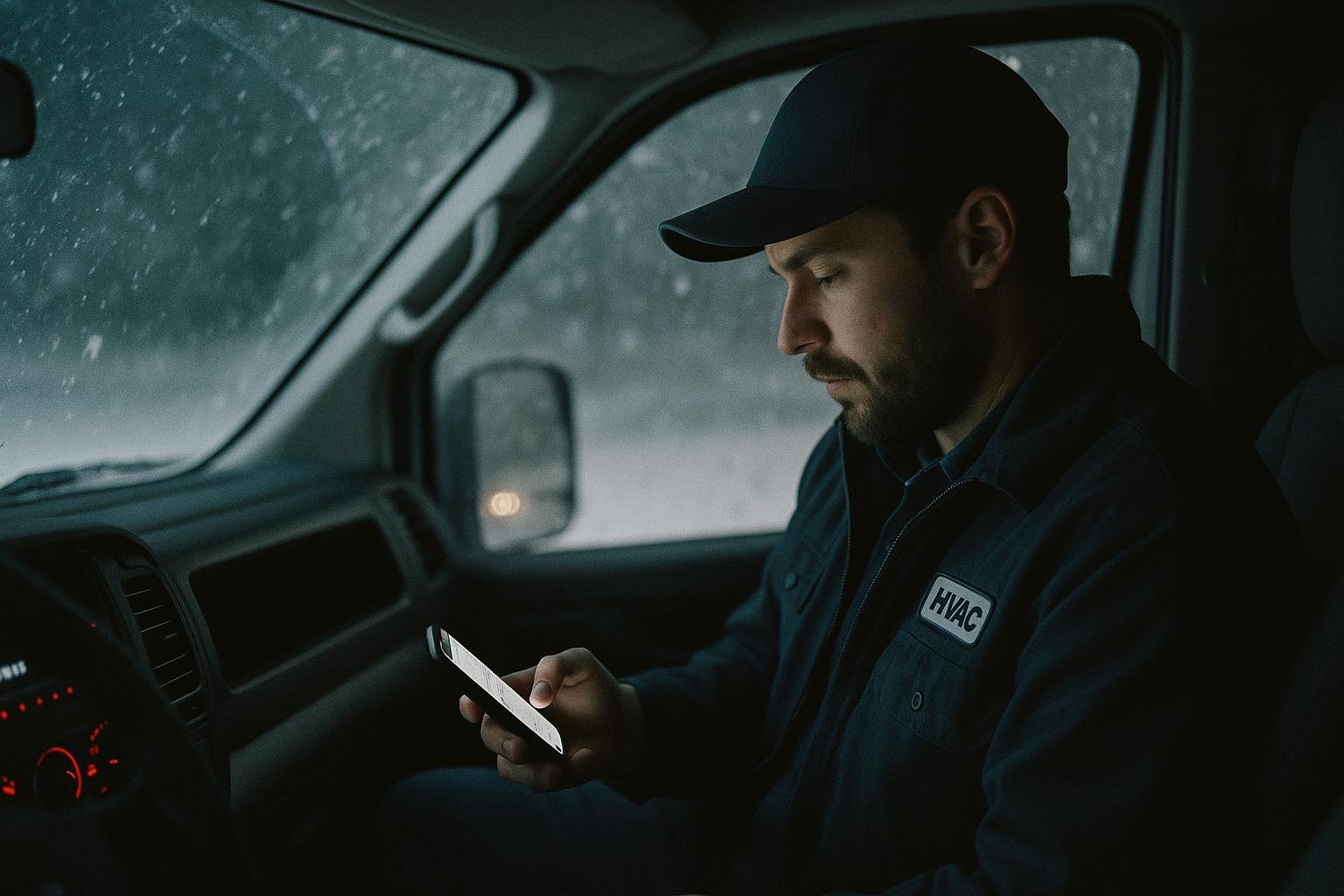
I Called Three HVAC Companies. Only One Answered.
An emergency hvac answering service ensures that when a homeowner's furnace dies in January, your company answers, not your competitor's voicemail. It qualifies the urgency in real time, captures the caller's details, and dispatches the job automatically, so you never lose a $2,000 service call to whoever picks up the phone first.
- 62% of calls to small businesses go unanswered — after midnight, that number is closer to 100% without dedicated coverage.
- A single missed emergency call in January can cost a residential HVAC company $2,000 or more in lost revenue.
- An AI answering service costs $600–$4,800 per year versus $30,000–$60,000 for a human on-call receptionist.
- Automatic text and email confirmation after every call closes the loop — the customer knows help is coming.
The Day My Furnace Died
It was a freezing January day and our furnace had just quit. If you've lived through that, you know the feeling. The house gets quieter, then colder, and you start doing math about how long the family can stay warm. My family was worried, and so was I.
I grabbed my phone and called the first HVAC company I found. No answer. I called the second. Nothing. These were small, independent outfits, the kind where the owner is probably under someone's sink while the phone rings. I wasn't angry at them for being busy. I was just a homeowner running out of options.
The third company picked up. A real voice said he'd be at my house in an hour. I didn't compare prices or read reviews. He answered, and that was the whole decision.
Here's what I think about now: the first two companies never found out. There was no voicemail, no missed-call alert, nothing to tell them a job had just walked away. They probably had a quiet day and never knew why.
What That Call Actually Cost You
Let's be specific. A residential furnace emergency in January — diagnosis, parts, labour — runs $1,500 to $2,500 depending on what's failed. Call it $2,000 flat. If that happens ten times over a winter season, and it does for any HVAC company doing real volume, that's $20,000 walking out the door. Not because your techs aren't good. Not because your pricing is wrong. Because nobody answered the phone.
And it's not just the job. That homeowner is now a loyal customer of your competitor. They'll call them for their annual tune-up. They'll refer them to their neighbour. One missed call becomes a customer relationship that lasts years.
According to BLS employment data, a full-time receptionist costs $30,000–$60,000 per year in wages alone — and that doesn't buy you 24/7 coverage. It buys you business hours. The emergency calls still go to voicemail.
Why It Keeps Happening
Here's the thing. Most HVAC owners I talk to already know they're missing calls. They've heard it from customers. They've seen the missed call log. The problem isn't awareness — it's that the obvious solutions don't actually work.
Hiring an after-hours answering service staffed by humans sounds good until you see the cost and realise those operators know nothing about your business. They're reading from a script, can't qualify an emergency from a routine tune-up request, and are routing everything to an on-call tech who then calls you at 1 AM asking what to do.
Having the owner carry the phone is fine in year one. By year three, when you've got four vans running, it's not sustainable and everyone in your household knows it.
The mechanism is simple: HVAC emergencies don't follow business hours, and the tools most companies use for call handling were built for business hours. That's the gap. And your competitors who figured this out are filling it every night.
Here's exactly what a missed-call situation looks like in practice — and what answering it actually sounds like on a real call:
How Does an Emergency HVAC Answering Service Work?
An AI-powered emergency HVAC answering service picks up every call — at 2 PM or 2 AM — in under one second. No hold music. No voicemail. A natural-sounding voice greets the caller with your company name, your branding, your tone.
But it doesn't just answer. It qualifies. The agent asks the right questions: Is the system completely down or intermittent? Is there heat at all? How many people are in the home? Is this a rental property? That information determines whether this is a true emergency or a next-morning appointment — and it routes accordingly.
Here's what the call flow looks like in practice:
- Caller rings your number — answered in under one second, any hour.
- AI greets them with your custom script and company name.
- Qualification happens in real time — emergency vs. routine, urgency level, location, issue description.
- Details are captured — caller name, phone, address, problem summary, urgency flag.
- Data is pushed out — via webhook to your dispatch system, or held in the call dashboard for your team to action first thing.
- Confirmation goes to the customer — automatic text and email recap: what was discussed, what happens next, who's coming.
That last step matters more than most people expect. The customer who called at midnight and got a confirmation text at 12:03 AM is not calling two more companies to see who responds. They know help is coming. That's the confirmation loop — and it's what separates a booked job from a lead that evaporated.
You can see the full feature set at CallagentAI — including how qualification, lead capture, and the confirmation loop are configured for your specific business.
What Changes the Morning After
Your dispatcher opens their laptop at 7 AM. Instead of a voicemail they have to listen to and transcribe, there's a structured record: caller name, address, problem description, urgency level, timestamp. Everything they need to assign the first job of the day — already there, already formatted, no phone tag required.
The homeowner got a text at 12:04 AM confirming a technician will call them first thing in the morning. They slept. You slept. The job is yours.
That's not a dramatic transformation. It's just closing a gap that's been costing you money every winter, quietly, call by call.
What Does an Emergency HVAC Answering Service Cost?
An AI emergency HVAC answering service typically runs $600–$4,800 per year depending on call volume and the plan you're on. Compare that to the alternatives:
| Option | Annual Cost | 24/7 Coverage | Emergency Qualification | Structured Handoff |
|---|---|---|---|---|
| Voicemail | $0 | No (unanswered) | No | No |
| Human answering service | $6,000–$18,000 | Depends on tier | Basic script only | Manual call notes |
| Full-time receptionist | $30,000–$60,000 | No (business hours only) | Yes, with training | Yes, manual entry |
| AI emergency HVAC answering service | $600–$4,800 | Yes, 24/7/365 | Yes, real-time | Yes, automated via webhook |
Real talk: a single recovered midnight service call at $2,000 covers the annual cost of the platform on most plans. Everything after that is margin you would have lost otherwise. Check the CallagentAI pricing page to see which tier fits your call volume.
The Automation Handoff — No Re-Entry, No Delay
One thing I want to be clear about, because I see a lot of vague claims in this space: the automation is real, but it works through structured data and webhooks — not magic logos on an integrations page.
When a call ends, CallagentAI pushes the structured call data — caller name, phone number, address, issue description, urgency level — out via webhook. If you run a field service platform like Jobber or ServiceTitan, you can wire that webhook through Zapier or Make so the job is waiting for your dispatcher without anyone typing it in. There's no native connector, but the data path is real and it works. Your dispatcher doesn't retype information. Your tech doesn't get a vague voicemail. The record exists, it's structured, and it's there when the morning starts.
Appointments can also be booked directly during the call through our Cal.com integration — so for non-emergency tune-up calls coming in overnight, the customer picks their slot and gets a confirmation without anyone being woken up.
Picture a three-van residential HVAC operation heading into January. They've missed calls every winter — not because they don't care, but because nobody's awake at midnight and voicemail doesn't qualify an emergency. After setting up an AI answering service, every overnight call gets answered and captured. The dispatcher opens the dashboard each morning to a list of structured records instead of a voicemail inbox. The homeowners who called at 2 AM already have a text confirmation. The jobs that used to vanish are now booked. That's the gap this closes — nothing more dramatic, nothing less real.
Frequently Asked Questions
Will callers know they're talking to an AI?
Some will notice, most won't — especially on a first call. The voices are natural and the conversation flows without robotic pauses. More importantly, for an emergency caller in a cold house, what matters is that someone answered and took their information seriously. Callers who get a fast, clear response and a confirmation text are satisfied regardless of who answered.
Can an AI really qualify an HVAC emergency versus a routine call?
Yes. The agent is trained on your specific qualification criteria — complete system failure, partial heat, rental vs. owner-occupied, number of occupants, temperature inside. It asks the right questions and flags urgency level in the structured record it hands off to your dispatcher. You define what counts as an emergency; the agent applies it consistently on every call.
What happens if the caller needs to speak to a real person?
The AI can transfer the call to a human at any point — your on-call tech, your emergency line, or your own mobile. You configure when transfers happen: immediately on certain trigger words, after qualification, or on caller request. The caller is never left without a path to a person if the situation genuinely requires it.
How does the call data get into our dispatch system?
After every call, CallagentAI pushes a structured record — caller name, phone, address, issue description, urgency flag — via webhook. If you run field service software like Jobber or ServiceTitan, you can connect that webhook through Zapier or Make to create the job automatically. There's no native connector, but the data path is real and removes the manual re-entry step entirely.
How quickly can we get this running?
Setup takes under 15 minutes for the basic configuration — your greeting, your qualification questions, your business hours, your transfer rules. You train the agent on your FAQs and service area, and it's live. There's no technical expertise required and no long onboarding process. Most HVAC companies are answering calls the same day they sign up.
What does an emergency HVAC answering service cost compared to a human operator?
An AI emergency HVAC answering service runs $600–$4,800 per year. A full-time human receptionist costs $30,000–$60,000 annually and only covers business hours. Human answering services with 24/7 coverage run $6,000–$18,000 per year. A single recovered $2,000 midnight service call typically covers the AI platform's cost for an entire year on most plans.
The bottom line? Your competitors are answering calls you're sending to voicemail. Not because they have bigger teams or better techs — because they set up an emergency HVAC answering service and you haven't yet. The calls are coming either way. The question is whose job board they land on. If you want to see what that sounds like before you commit, the demo page has live examples.