Dental Practice: Why Patients Are Switching to Offices That Answer
A dental answering service is the difference between keeping a patient and losing them to the practice two blocks away. When someone calls with a cracked tooth at 7 PM and hits your voicemail, they don't wait — they dial the next result on Google. An AI-powered dental answering service answers every call, 24/7, qualifies the urgency, and books the appointment before that patient ever considers leaving.
- 62% of calls to small businesses go unanswered — dental practices are no exception.
- A missed emergency call is rarely a missed call — it's a lost patient relationship, often permanently.
- AI answering services cost $300–$500/month versus $30,000–$60,000/year for a human receptionist.
- Patients tell friends about bad experiences. One missed call can cost you more than one appointment.
The Moment You Lose Them
Picture this. It's 6:45 on a Tuesday evening. A patient — let's call her Maria — bites down on something hard at dinner and feels that unmistakable crack. Immediate panic. She grabs her phone, searches "emergency dentist near me," and taps the first result: your practice.
Ring. Ring. Ring.
Voicemail.
She hangs up without leaving a message — most people do — scrolls down, and taps the second result. That office answers. A calm, professional voice asks her a few questions, confirms an appointment for first thing Wednesday morning, and texts her a confirmation within seconds. She shows up Wednesday. She becomes a regular. Her husband starts going there too.
You never even knew she called.
That's the scenario that keeps me up at night as someone who builds tools for exactly this problem. It's not dramatic. It's just Tuesday evening, a ringing phone, and a practice that wasn't ready.
What Does a Missed Call Actually Cost a Dental Practice?
The honest answer: more than most practice owners think. A new dental patient is worth an average of several thousand dollars in lifetime value — cleanings, X-rays, fillings, the occasional crown. Lose Maria at that first call, and you're not losing a single appointment. You're losing the relationship.
And here's the part people underestimate. She talks. Not necessarily in a vindictive way — just in the ordinary way people talk. "Oh, you need a dentist? I just found a great one. My old place never answered their phone." That's not a Yelp review. That's a conversation at a school pickup, and it's more persuasive than anything you could put in an ad.
According to BLS data, a full-time front-desk receptionist costs $30,000–$60,000 per year in salary alone, before benefits. And even a dedicated, excellent receptionist can't be in two places at once during a busy lunch rush, can't answer calls after 5 PM, and takes sick days. The phone goes unanswered. The Marias of the world move on.
Why It Keeps Happening
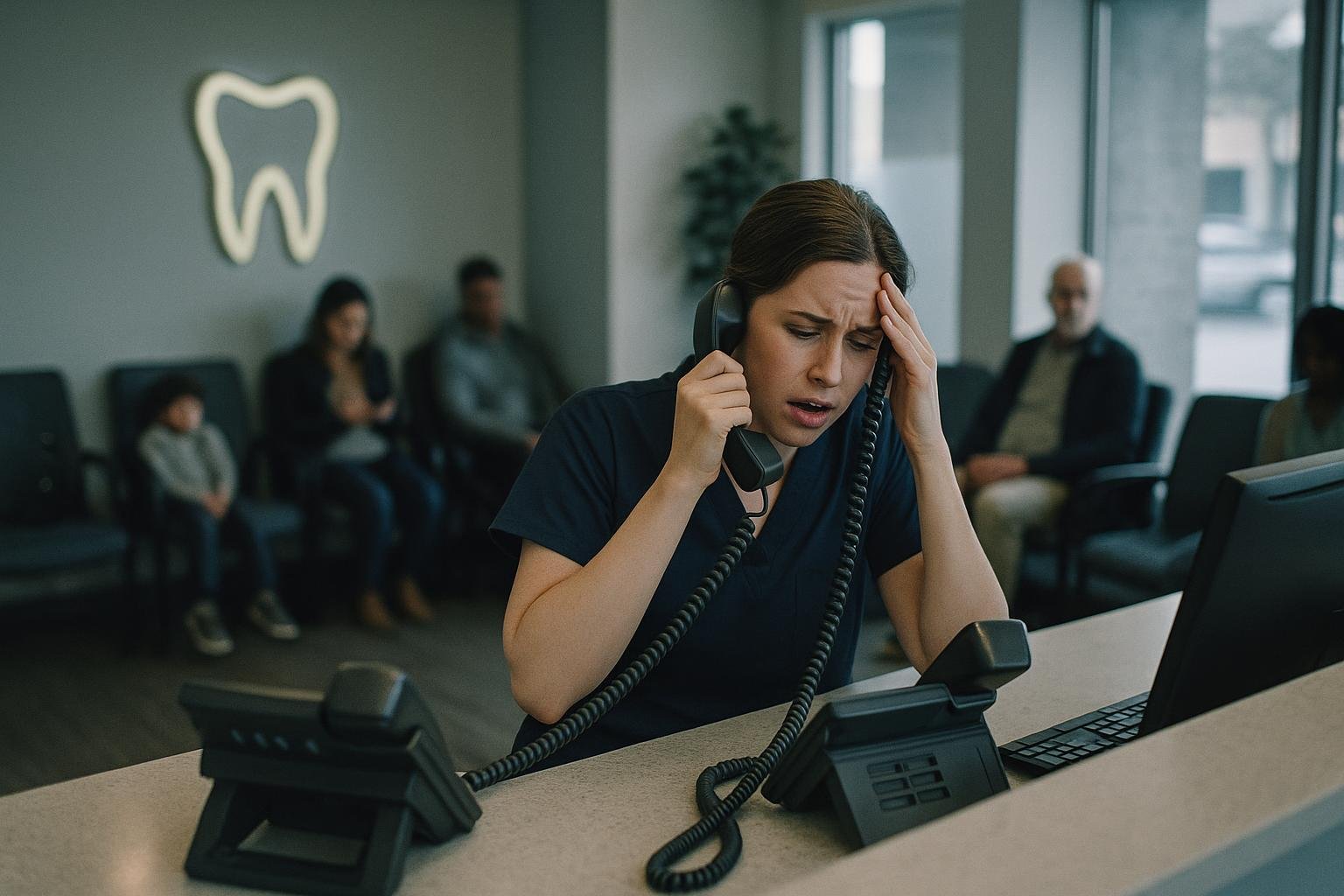
Dental practices aren't dropping calls because they don't care. They're dropping calls because the front desk is genuinely overwhelmed. Think about what a receptionist juggles in a typical morning: checking patients in, processing insurance, confirming tomorrow's appointments, answering questions in the waiting room, and yes — trying to answer the phone every time it rings.
Something always loses. Usually it's the inbound call from someone who hasn't walked through the door yet.
After-hours is even simpler: no one's there. The phone rings into voicemail. The patient with a broken tooth is in pain, anxious, and not in the mood to leave a detailed message and hope someone calls back by 9 AM. They want an answer now. And the practice down the street — the one that set up an AI dental answering service six months ago — gives them one.
That's the mechanism. It's not negligence. It's a staffing structure that was built for a world where patients only called during business hours and were willing to wait. That world is gone.
What Does a Dental Answering Service Actually Do?
A good dental answering service does four things on every call, and it does them without putting anyone on hold.
First, it answers. Under one second, every time, whether it's 2 PM on a Monday or 11 PM on a Sunday. The caller hears a professional greeting customized to your practice — your name, your tone, your hours.
Second, it qualifies. Is this a dental emergency — severe pain, trauma, a lost crown that's causing distress? Or is it a routine cleaning request? The AI distinguishes between these in real time, using a conversational flow you define. Emergencies get routed appropriately; routine requests get booked.
Third, it captures. The caller's name, phone number, the nature of their concern, their preferred appointment time — all captured as structured data, not a voicemail someone has to transcribe by hand.
Fourth, it closes the loop. The patient gets a text and email confirming what was discussed and what happens next. Your team gets the same information, ready to act on the first thing in the morning. No ambiguity. No missed context. No "I thought someone else handled it."
Here's what that sounds like on a real AI receptionist call — this demo shows exactly the kind of interaction a patient would experience:
The appointment booking piece connects directly to Cal.com, so patients can be booked in real time during the call — no callback required, no back-and-forth. Check out the full features page to see what's included.
AI Dental Answering Service vs. Human Receptionist
I want to be honest here because I think the comparison is often oversimplified. A human receptionist does things an AI can't — read a room, handle a genuinely complex insurance dispute, calm a frightened child in the waiting area. I'm not suggesting you fire your front desk.
What I am saying is that your front desk shouldn't be your only line of call coverage. Here's a straightforward comparison:
| Factor | Human Receptionist | AI Dental Answering Service |
|---|---|---|
| Availability | Business hours only | 24/7/365 |
| Concurrent calls | One at a time | Unlimited — no busy signals |
| Annual cost | $30,000–$60,000 | $3,600–$5,760/year (~$300–$480/mo) |
| Sick days / holidays | Yes | None |
| Call transcript | Manual notes, if any | Automatic, every call |
| After-hours coverage | Voicemail or answering service | Full AI handling, real-time booking |
| Emergency triage | Depends on training | Consistent, configured by you |
The right answer for most practices is both — a human at the desk during the day and an AI dental answering service covering everything else. That's not replacing anyone. That's closing a gap that's currently costing you patients.
How It Plugs Into Your Practice
One concern I hear a lot from practice managers is: "We already have systems. We don't want another thing to manage." That's fair, and it's a reason I built CallagentAI the way I did.
Setup takes under 15 minutes. You upload your practice information — hours, services, FAQs, emergency protocols — and the AI learns from it. The greeting uses your practice name. The call flow matches how you actually handle different types of inquiries. You can adjust it any time yourself, no developer required.
For the handoff into your existing practice management system: the AI captures the call data as structured fields and pushes it out via webhook. If you use a tool like Zapier or Make, you can wire that webhook to create a new patient record or flag an inquiry in whatever system your practice already runs. No rip-and-replace. No data silos. The information flows where your team already looks.
The confirmation loop — automatic text and email to the patient after every call — is built in. Your patient knows what was discussed, what happens next, and when to expect a follow-up. That clarity alone cuts the "I called but never heard back" complaints that erode patient trust.
A note for HIPAA-sensitive implementations: if your workspace requires HIPAA compliance, some model options are restricted. The setup wizard will guide you through what's available for your configuration. See the full picture on the pricing page.
And honestly? The setup experience is the part most people are surprised by. It's not a months-long integration project. It's an afternoon. One of our food-service customers, Palma Pasta, put it this way after setting up their own multi-line AI system: "The most work that happens is uploading the information to Call Agent. After that it was easy sailing." Dental practices have found the same thing — the lift is front-loaded and small.
Frequently Asked Questions
Will patients know they're talking to an AI?
Some will, some won't — and in our experience, most don't mind when the AI is helpful and professional. The voices available through a quality dental answering service sound natural and conversational, not robotic. What patients care about is getting an answer. Being greeted immediately and booked efficiently matters far more than whether the voice belongs to a person.
Can a dental answering service handle emergency calls?
Yes — and this is where it earns its keep. You configure the emergency protocol yourself: what questions to ask, what urgency levels to distinguish, and where to route genuine emergencies (a direct transfer to an on-call number, for example). The AI qualifies the call in real time so your team isn't sorting through a pile of voicemails at 8 AM to find the one that mattered.
How much does a dental answering service cost?
An AI dental answering service typically runs $300–$500 per month, compared to $30,000–$60,000 per year for a human receptionist. That's an 87–97% cost reduction for 24/7 coverage. Most practices recoup the cost with a single new patient per month — and that's a conservative estimate given the lifetime value of a retained dental patient.
Does it integrate with my existing practice management software?
Directly named connectors depend on the platform, but CallagentAI pushes structured call data via webhook to any system. If you use Zapier or Make, you can route that data into your existing practice management software without anyone manually retyping information. The booking integration with Cal.com is native and works during the call in real time.
What happens if the AI can't answer a patient's question?
You configure a transfer protocol for situations that need a human. If the AI reaches a question it can't resolve — a complex insurance situation, a patient in distress — it routes the call to the appropriate person. Outside of hours, it captures the details fully so your team has everything they need when they're back in the office. Nothing disappears into a voicemail nobody heard.
How long does setup take?
Most practices are live in under 15 minutes. You provide your practice information — hours, services, emergency protocols, FAQs — and the AI is trained on it immediately. No developer required, no lengthy onboarding call. You can adjust the greeting, call flow, and routing any time yourself through the dashboard. If you want to see it before committing, the demo page walks through a live example.
The CTA That Isn't Really a CTA
Look — I'm not going to tell you that a dental answering service is going to save your practice. You're running a good practice. What I will say is that the practices gaining ground right now are the ones that answer.
Every Maria who calls after hours and hits voicemail is making a choice in the next 30 seconds. She's choosing between your practice and the one that picks up. That's not a loyalty decision. That's a pain-driven, time-sensitive, I-need-help-right-now decision. And whoever answers wins it.
If you want to see what this actually looks and sounds like for a dental practice, the demo is right here. No sales call required. Just the product, working.