
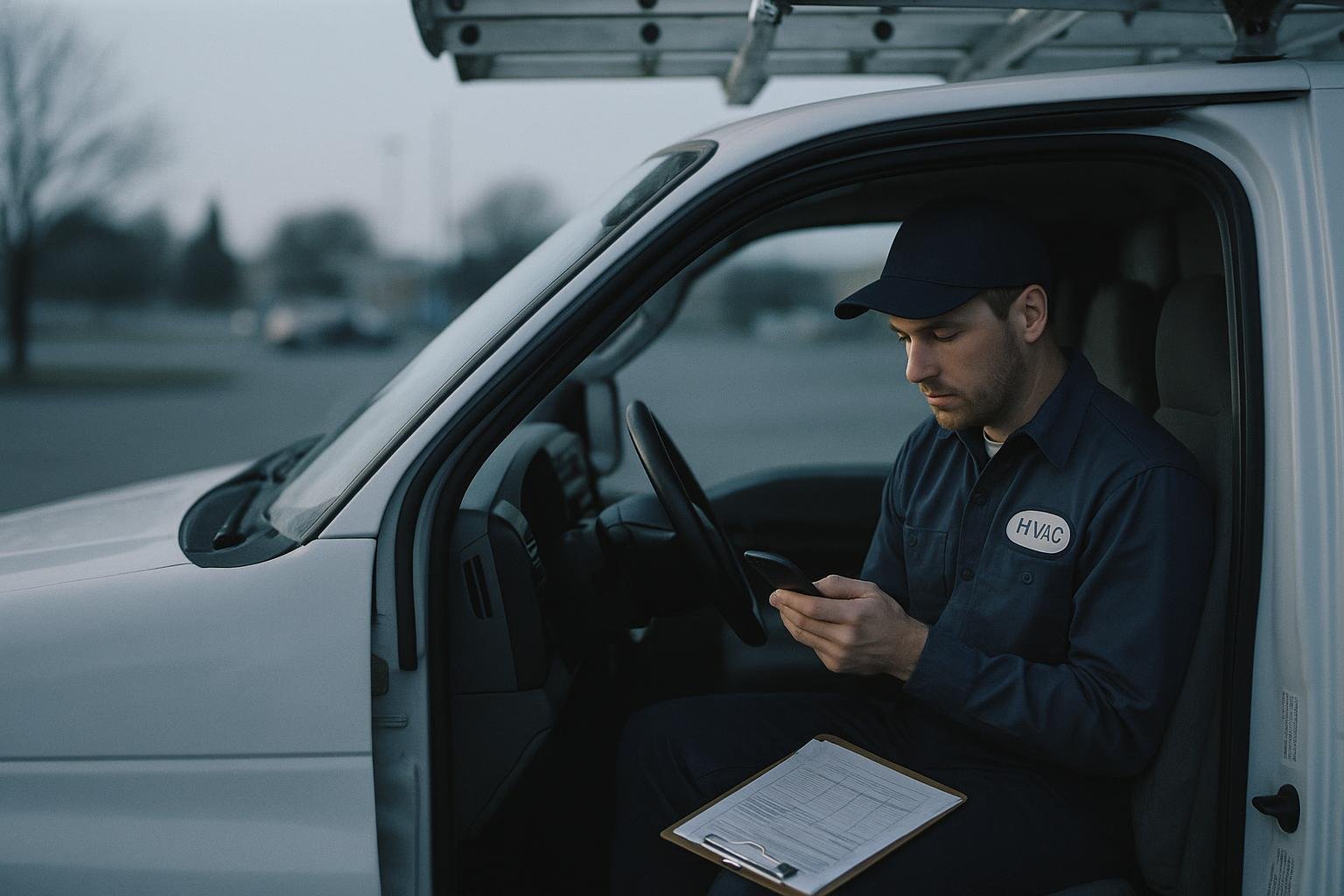
Why Your $600K HVAC Contract Is at Risk (And You Don't Know It)
I recently had a conversation with a commercial HVAC owner in Ohio about the challenges of running his business. The more we talked, the more one problem stood out: the phone. It got me thinking about how much a single missed call can actually cost a commercial contractor, and that's what this article is about.
A commercial HVAC answering service is a 24/7 call-handling system that answers every facilities manager call in real time, qualifies the issue, and pushes the details to your dispatch team — so no SLA clock starts ticking against you while your phone goes to voicemail. Without one, a single unanswered call from the wrong person at the wrong moment can trigger an account review that costs you six figures.
- Facilities managers operate under strict SLAs — even one missed call can initiate a formal contract review.
- A single commercial HVAC account can be worth $600K–$2M annually; voicemail is not a safe fallback.
- AI-powered call handling qualifies emergencies in real time and delivers structured data to dispatch — no retyping, no delay.
- An automated confirmation loop (text + email after every call) creates documented proof of response, which protects the contract relationship.
The Moment You Lose the Contract
Picture this. It's 7:14 AM on a Tuesday. Your lead tech is already under a rooftop unit at a distribution centre across town. Your dispatcher hasn't logged in yet. And the facilities manager for your biggest account — the one running 11 properties under a single portfolio — calls your main number because the HVAC in her main office building went down overnight.
She gets voicemail.
She calls again at 7:22. Voicemail again. By 7:45, she's sent an email flagging a potential SLA breach. By 8:30, she's already called two of your competitors to get a quote. Not because she wants to leave — she doesn't. She just needs to show her VP that she's managing the situation. And now your name is on a list of vendors under review.
You didn't miss a call. You missed a $600K account renewal.
What a Missed Call Actually Costs
The money story in commercial HVAC isn't about a single service ticket. It's about the account. A mid-sized commercial HVAC contractor holding facilities management contracts across a regional portfolio is looking at anywhere from $600K to $2M in annual recurring revenue per anchor client. Those contracts get renewed — or cancelled — based on perceived responsiveness as much as technical performance.
Here's what the research actually shows. According to the U.S. Bureau of Labor Statistics, a full-time receptionist runs $30,000–$60,000 per year in salary alone — before benefits, turnover costs, or the fact that she goes home at 5 PM. Meanwhile, the broader market for AI voice agents is growing at a 45.8% compound annual growth rate, driven precisely by companies that have done that math and don't like the answer.
But the number that should keep you up at night isn't the cost of a receptionist. It's the cost of one account walking out the door because a facilities manager couldn't reach you during an early-morning emergency. That's not inefficiency. That's a business-threatening event dressed up as a phone problem.
Why It Keeps Happening Even at Good Companies
I talk to commercial HVAC contractors who run tight operations. Experienced techs. Good equipment. Strong track records. And almost every one of them has the same gap: the phone.
Not because they don't care. Because the phone problem is genuinely hard to solve with people. Your dispatcher works business hours. Your after-hours line goes to a personal cell, which sometimes gets answered and sometimes doesn't. Your on-call tech is great at fixing equipment but not trained to capture caller name, property address, unit ID, urgency level, and SLA tier in the first 90 seconds of a call. And your main number? Voicemail, probably — because nobody has the budget to staff it around the clock.
Facilities managers know all of this. They've seen it before. What they're evaluating, constantly, is whether you're the kind of operation that treats their call like an emergency — or one that treats it like something that can wait until business hours. One missed call at the wrong moment confirms the wrong answer.
Here's the embedded demo of what an AI receptionist actually sounds like on a real call — because "AI" sounds abstract until you hear it qualify an emergency in under 60 seconds:
What a Commercial HVAC Answering Service Actually Does
A commercial HVAC answering service is a dedicated call-handling system — in CallagentAI's case, an AI voice agent — that answers every inbound call immediately, regardless of the hour. Not with a menu tree that makes callers press 4 for emergencies. With a natural-sounding voice that asks the right questions and actually listens to the answers.
On a commercial account, that means the agent knows how to ask: Is this an emergency or a routine service request? Which property? What's failing — total outage, partial, or performance issue? Is anyone in the building affected right now? What's the best number for a callback?
That's not a script recitation. That's real-time qualification. And the output isn't a voicemail someone has to listen to at 8 AM. It's a structured record — caller, property, problem type, urgency level — pushed directly to your team through a webhook the moment the call ends. Your dispatcher sees it when they log in. Or if it's a genuine emergency, you've configured the agent to transfer the call to a live person immediately.
Then the confirmation loop fires. The caller — your facilities manager — gets a text and an email summarising exactly what was captured and what happens next. She has written proof that her call was received and documented. That matters enormously in a contract relationship where SLA compliance is tracked.
See what our full feature set looks like, including real-time qualification, call transfer, and the confirmation loop.
How Does a Commercial HVAC Answering Service Work?
The setup is simpler than most contractors expect. You train the agent on your business — your properties, your SLA tiers, your escalation rules, your business hours — and it handles every call from that point forward. CallagentAI goes live in under 10 minutes, with no technical background required.
The call flow on a commercial account looks like this:
- Call comes in — the agent answers in under one second, every time, with your custom greeting.
- Real-time qualification — emergency vs. routine, property ID, urgency level, caller contact info.
- Immediate handoff decision — emergency calls transfer to your on-call tech or dispatcher; routine calls are logged and queued.
- Structured data pushed out — all captured fields go to your team by webhook, which you can wire into your existing dispatch system through Zapier or Make. No manual retyping.
- Confirmation loop — the caller receives a text and email recap of everything discussed, so there's no ambiguity about what was reported or what's coming next.
The agent doesn't have bad days. It doesn't miss the call at 6:50 AM because it isn't clocked in yet. And it doesn't hand the facilities manager a voicemail box and a prayer.
Before and After: What Changes on Day One
| Without a Commercial HVAC Answering Service | With CallagentAI |
|---|---|
| Facilities manager calls at 6:55 AM — voicemail | Answered in under 1 second, every call |
| Tech takes the call, misses half the details | Structured data captured: caller, site, urgency, contact |
| Dispatcher re-enters info manually from a voicemail | Data pushed by webhook — no retyping, no delay |
| Caller wonders if anyone got the message | Text + email recap sent automatically after every call |
| SLA breach flagged; contract review initiated | Documented response — account protected |
| Staffing cost: $30K–$60K/year for a receptionist | AI answering service: $600–$4,800/year |
That cost comparison alone is striking — an 87–97% reduction versus a full-time receptionist — but the real number is the contract value you're protecting, not the salary you're saving.
Does It Fit the Tools You Already Run?
Honestly, this is the question I get most often from commercial contractors. They're already running dispatch software, CRMs, scheduling tools. They don't want another platform that lives in a silo.
The answer is: it fits because it pushes data out, not in. CallagentAI sends structured call data through a webhook after every call. If you run your dispatch workflow in a system that connects to Zapier or Make, you can wire that webhook to create records automatically — no one typing it in. You keep the tools you use. You just stop having a human in the middle transcribing a voicemail.
Native integrations include Cal.com for live appointment booking and Zoho CRM for automatic record creation. For other systems, the webhook is the path — and it covers most of what commercial contractors actually need.
The carrier situation is flexible too. CallagentAI supports Twilio and Telnyx, and if you're running a SIP or VoIP setup already, BYOC is supported — so you're not ripping out your phone infrastructure to make this work.
Frequently Asked Questions
What is a commercial HVAC answering service?
A commercial HVAC answering service is a 24/7 call-handling system — typically AI-powered — that answers every inbound call from facilities managers and commercial clients, qualifies the issue in real time, routes emergencies to your team, and delivers structured data to dispatch automatically, with no voicemail and no missed calls.
How much does a commercial HVAC answering service cost?
An AI-powered commercial HVAC answering service runs roughly $600–$4,800 per year depending on call volume and plan. A full-time human receptionist costs $30,000–$60,000 per year in salary before benefits. That's an 87–97% cost reduction for equivalent or better availability — and unlike a person, the AI answers at 6 AM on a Sunday.
Can an AI answering service handle emergency calls from facilities managers?
Yes. A well-configured AI agent qualifies calls in real time — emergency versus routine, urgency level, affected property — and immediately transfers emergency calls to your on-call tech or dispatcher. Non-emergency calls are logged with full structured data pushed to your team, so nothing waits in a voicemail queue until business hours.
Will the facilities manager know they're talking to an AI?
Modern AI voice agents sound natural and respond in real time. More importantly, facilities managers care about response speed and documented follow-through — not who answered. The automatic text and email recap after every call is often what impresses them most: clear, written proof that their call was received and actioned.
Does it integrate with my existing dispatch software?
CallagentAI sends structured call data through a webhook after every call. You can route that data into your existing dispatch or field-service tools via Zapier or Make. Native integrations include Zoho CRM and Cal.com for appointment booking. There's no rip-and-replace — it layers onto what you already run and removes the manual data-entry step between the call and your dispatcher.
What happens if the AI can't handle the call?
You configure the handoff rules. If the caller's issue exceeds what the agent is set up to handle — or if they specifically ask for a person — the agent transfers the call to your designated human. Every call is recorded and transcribed, so your team always has the full context, even on transferred calls where the AI only handled the first 60 seconds.