
Automotive Answering Service: AI Call Handling for Auto Repair Shops
I spent about fifteen years in food service operations before I ever touched a line of software, and I learned one thing the hard way: the phone always rings at the worst possible moment. Lunch rush, a delivery at the back door, someone short-staffed, and there it goes again. You know there's money on the other end of that line, and you physically can't get to it. My solution back then was to answer with one hand, plate with the other, and say "can you hold?" to people who had not yet said a single word. Nobody ever wrote that up as a best practice. When we started building a service-booking agent for a Toyota dealership demo, I recognized that feeling right away. A service advisor juggling three customers at the counter and a technician under a lift are living my old lunch rush every single morning. The difference is they're actually good at their jobs. I just burned the garlic bread. That's who this article is for.
An automotive answering service is an AI-powered phone system that answers every call to your shop (appointments, quotes, breakdowns) 24/7, without pulling a technician out from under a vehicle. At CallagentAI, plans start at $45/month with no setup fees and a free trial to start.
- In the most widely cited study on the subject, 62% of calls to small businesses went unanswered. Auto shops have it worse, because the people who know the answers are holding a wrench.
- An AI automotive answering service qualifies the caller in real time: oil change vs. blown transmission vs. stranded on the highway.
- Calls produce structured data (name, phone, vehicle, issue, urgency) instead of a voicemail nobody hears until 4 PM.
- Setup takes under 15 minutes. No IT department. You keep your phone number and whatever CRM you already run.
The Missed-Call Problem in Auto Repair
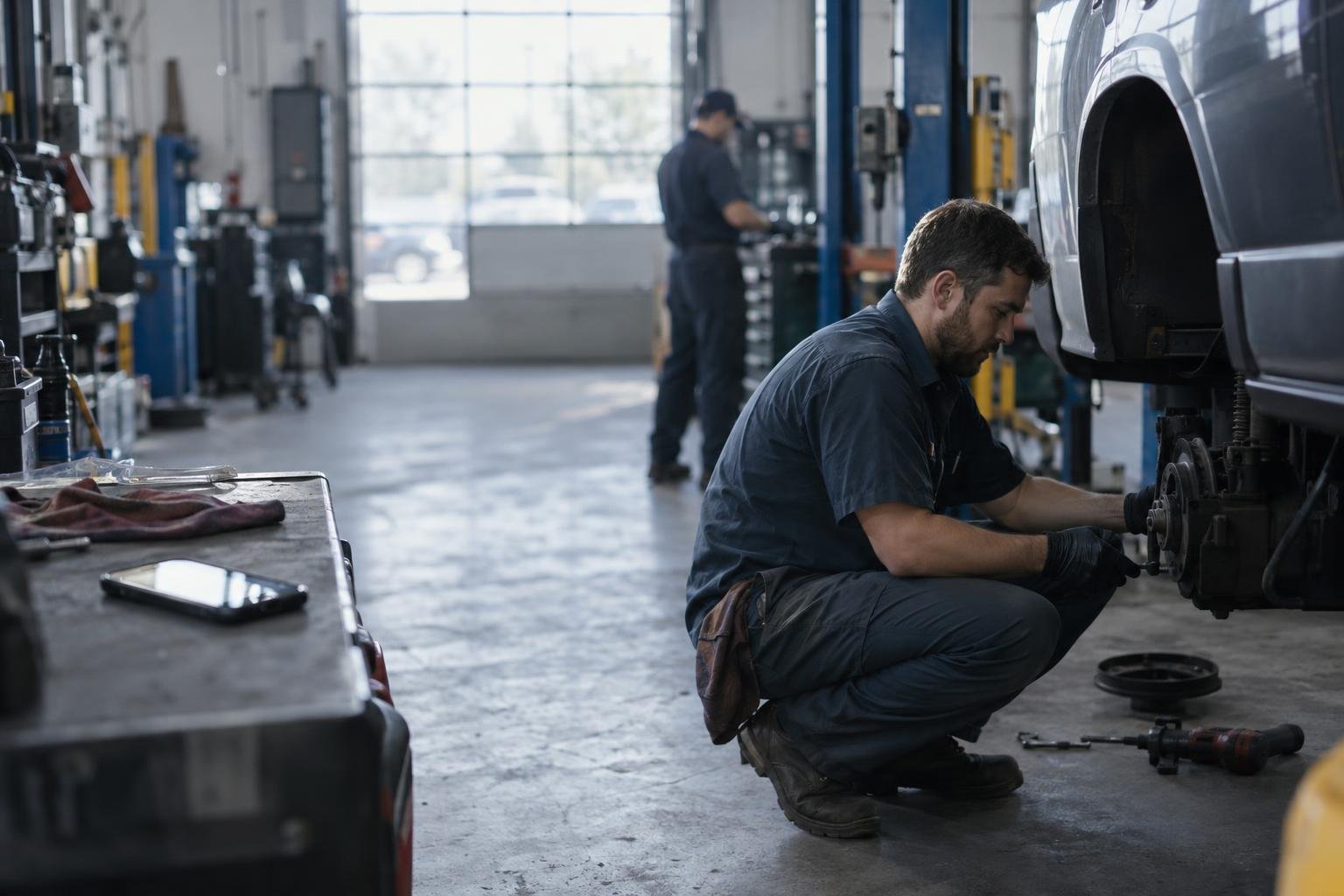
It's 8:47 AM on a Tuesday. Three cars are already on lifts, a parts delivery is due at nine, and your front-desk person called in sick. The phone rings. Then again. Then a third time. By the time anyone gets to it (if anyone does), that caller has found the next shop on Google Maps and booked there.
That's not a hypothetical. When 411 Locals tracked calls to 85 small businesses for 30 days, only 37.8% were answered by a live person. The rest went to voicemail or rang out. That study is old and small, but nobody who runs a shop is surprised by it. For auto repair the number is probably worse, because your techs are physically unable to pick up. They're under a car. (I once tried to change my own oil while taking a call. Ask my driveway how that went.)
Every one of those missed calls has a dollar value. An average ticket at an independent shop runs $300–$600. Miss five calls on a Monday morning and you've potentially walked away from $1,500–$3,000 before lunch. Not because your work is bad. Because nobody answered.
Why It Keeps Happening
Most shop owners already know this is a problem. The issue isn't awareness. It's that the obvious fixes don't work.
Hiring a dedicated receptionist costs $30,000–$60,000 a year once you add taxes and benefits to wages, based on Bureau of Labor Statistics data on receptionist pay. For a two-bay independent shop, that math doesn't work. And even if you can afford it, one receptionist handles one call at a time. During the morning rush, callers still sit on hold, or give up.
Voicemail is worse. People calling about a same-day oil change or a brake check before a road trip don't want to leave a message and wait. They want an answer, so they call the next shop on the list.
IVR trees ("press 1 for service, press 2 for parts") are marginally better but still feel cold. They don't answer questions. They don't book appointments. They just delay the dead end. I'll admit I've mashed zero so hard trying to reach a human that I'm fairly sure I owe my phone an apology.
The root cause is simple: auto repair is a floor-level business. The people running it are doing the work, not sitting at a desk. And the phone system most shops use was designed for offices.
That gap, between how a shop actually operates and what a traditional phone system demands, is exactly what an automotive answering service is built to close.
What an Automotive Answering Service Actually Does
An automotive answering service isn't a voice robot that says "we're closed, please call back." The modern AI version does four concrete things on every call.
1. Answers immediately, every time
Under one second. No hold music. No voicemail. The caller hears a natural-sounding voice that knows your shop's name, hours, services, and current availability, whether it's 11 PM on a Sunday or 8 AM on the busiest Monday of the year.
2. Qualifies the call in real time
Not all calls are equal. Someone asking about wiper blades is very different from someone whose check engine light just started flashing on the highway. A good automotive answering service separates these, asks the right follow-up questions, and routes urgent situations to a human immediately, while handling routine questions on its own.
3. Captures structured data, not audio
When a call ends, you don't get a recording to sit through. You get fields: caller name, phone number, vehicle make and model, the issue, preferred appointment time, and urgency. That flows into a Google Sheet, HubSpot, or Zoho CRM, wherever your team already looks. See the integrations page for what connects natively.
4. Closes the loop with the customer
After the call, the customer automatically gets an SMS and email recap: what was discussed, what happens next, when to expect a confirmation. No "I thought I booked it but I'm not sure." That confirmation loop is what turns a decent AI call into a great customer experience.
How Does an Automotive Answering Service Work?
An automotive answering service routes your shop's existing phone number through an AI voice agent trained on your business: your services, prices, hours, and team. When a call comes in, the AI answers in under a second, holds a natural conversation, captures the caller's information, books the appointment if calendar integration is on, and delivers the call data to your team as structured fields.
Setup at CallagentAI takes under 15 minutes. You upload your shop's FAQs, service list, hours, and any special instructions, and the AI is trained on them. Connect Cal.com for live booking during the call, or connect HubSpot or Zoho CRM to log every caller as a contact. Here's the part I care about most: we don't make you switch systems. If your shop management software has no native connector, a webhook to Zapier, Make, or n8n puts the call data wherever you need it. Your stack stays your stack.
Calls that need a human get transferred immediately. The AI never pretends it can authorize a repair or give a firm parts quote. It captures the request and routes it. Want to hear that handoff for yourself? Call the live demo and try to stump it. Fair warning: it's more patient on the phone than I am.
What Does an Automotive Answering Service Cost?
This is usually the first question, so here's the straight breakdown. A human receptionist runs $30,000–$60,000 per year all-in. An AI automotive answering service on CallagentAI starts at $45/month.
| Option | Monthly Cost | Annual Cost | Available 24/7? | Handles concurrent calls? |
|---|---|---|---|---|
| Human receptionist | $2,500–$5,000 | $30,000–$60,000 | No | No, one at a time |
| Traditional answering service | $300–$500 | $3,600–$6,000 | Sometimes | Limited |
| CallagentAI Starter AI | $45/mo | $540 | Yes | Yes |
| CallagentAI Growth AI | $120/mo | $1,440 | Yes | Yes |
Starter AI at $45/month includes roughly 90 minutes of call handling at the standard voice rate ($0.45/min), inbound calls and transcriptions, Cal.com booking, Google Sheets logging, and SMS and email automations. Growth AI at $120/month includes roughly 750 minutes at $0.16/min, plus outbound call campaigns and priority support. See the pricing page for full details. When your balance drops below 20% of included minutes, auto top-up adds 20% more at 20% of the plan price, so a call in progress never drops mid-conversation.
CRM integration (Zoho, HubSpot) and custom webhooks are add-ons on Starter AI and Growth AI ($20/mo and $25/mo respectively), and are included on Pro AI ($225/mo) and Elite AI ($1,399/mo).
Run Your Own Numbers
I'm going to be straight with you, because a shop owner can smell a sales pitch from across the parking lot. And I'm a founder writing a blog about my own product, so you've already got your guard up. Fair. Ninety minutes is a trial-sized tank. A busy shop taking 10 to 15 calls a day at two or three minutes each burns through that in under a week. Most repair shops belong on Growth AI.
So do the real math. Say you get 300 calls a month at an average of 2.5 minutes. That's 750 minutes, which is exactly what Growth AI covers for $120. Now look at the other side of the ledger: if the AI catches just one job a month that would have gone to voicemail, a single $400 brake job pays for more than three months of service. Catch one a week and you're looking at roughly $1,600 a month in recovered work against a $120 bill.
That's the question worth asking. Not "what does it cost?" but "what is the ringing phone already costing me?"
AI Call Handling for Auto Detailing Shops
Detailing is a different animal from repair. Nobody calls at midnight because their ceramic coat is peeling. But detailers deal with high call volume relative to staff size. A one- or two-person shop is usually the owner doing the work, the scheduling, the quoting, and the follow-up, all at once.
The calls are predictable: how long does a full detail take, what's the difference between basic and premium, do you do engine bays, can I book Saturday. An automotive answering service handles all of these on its own. It knows your packages, pricing, turnaround times, and availability. It books the appointment, texts the confirmation, and logs the contact before you've finished buffing the hood in front of you.
Picture a two-person detailing operation on a Friday afternoon. Both detailers are deep in an SUV interior with two hours to go. Three calls come in between 2 PM and 4 PM. Without an answering service, those callers hang up and try somewhere else. With one, all three get answered, two book Saturday slots on the spot, and the third gets a callback scheduled automatically. The owner sees all of it in a Google Sheet before locking up.
That's not magic. It's what happens when you close the gap between a ringing phone and an owner too busy working to answer it.
Why It Holds Up in the Real World
When we started building CallagentAI, the clearest use case wasn't tech-forward companies. It was businesses where the owner is physically doing the work. A tech under a vehicle can't answer the phone. A detailer with a buffer in hand can't answer the phone. I couldn't answer it with a full dining room either, and I didn't even have a buffer as an excuse. Just a lot of soup. That's the whole problem, and you don't solve it by telling people to try harder.
What we've seen across customer accounts is that the confirmation loop, the automatic SMS and email recap after every call, does something answering alone doesn't: it makes the customer feel heard. They got a summary. They know what was said. They know when to expect their car. That's the detail that turns a first-time caller into a regular.
The integration story matters too. Run HubSpot, and every AI-answered caller lands on your contact timeline with a transcript and call outcome. Use Zoho, and leads get created and updated from every call. No CRM yet? Google Sheets logs every call on every plan. No dispatcher re-typing what a caller said. The data is in the right place the moment the call ends.
Explore the full feature set, including call transfer logic, multi-language support, and how the AI handles calls it can't resolve on its own.
And this isn't a niche experiment anymore. Market.us estimates the AI receptionist market at $2.7 billion in 2025, on track for $31.3 billion by 2035. That growth is coming from businesses exactly like auto repair and detailing: lots of calls, thin staff, and no appetite for another $50,000 salary.
Frequently Asked Questions
What is an automotive answering service?
An automotive answering service is a system, either human-staffed or AI-powered, that handles phone calls for an auto repair or detailing shop. A modern AI version answers every call instantly, qualifies the caller's need, books appointments, captures contact information, and sends the caller a confirmation text, without anyone at the shop picking up.
How much does an automotive answering service cost?
AI-powered automotive answering services cost a fraction of a human receptionist. CallagentAI's Starter AI plan is $45/month with roughly 90 minutes at $0.45/min. Growth AI is $120/month with roughly 750 minutes at $0.16/min, which fits most busy repair shops. Human receptionists run $30,000–$60,000 per year including taxes and benefits.
Can an AI answering service book appointments for auto repair?
Yes. CallagentAI integrates natively with Cal.com for live booking during the call. The AI reads open time slots in real time and books the visit before the caller hangs up. The customer automatically receives an SMS and email confirmation, so nobody has to follow up to confirm it was recorded.
What happens when a caller has a question the AI can't answer?
The AI transfers the call to a human when a situation is outside its scope: a specific parts quote, an in-person diagnosis, or anything that needs a technician's judgment. Transfer logic is fully configurable. For everything else, the AI handles the call, captures the data, and closes the loop with the customer.
Does an automotive answering service work for auto detailing shops?
Absolutely. Detailing shops get predictable, high-volume calls about packages, pricing, availability, and booking. An AI automotive answering service handles all of them, books the appointment, sends a confirmation text, and logs the customer's details. It's especially useful for one- or two-person operations where the owner is doing the work.
Is it hard to set up an AI answering service for a shop?
No. CallagentAI setup takes under 15 minutes. Upload your service list, hours, FAQs, and any special instructions, and the AI is trained on them. You keep your existing phone number and your existing software. No technical expertise required, and you can update the AI's knowledge anytime from the dashboard.
Final Thoughts
Your shop doesn't lose jobs because the work is bad. It loses them because the phone rings while everyone's hands are full. An automotive answering service fixes that for less than the cost of one recovered brake job a month. Every call answered, every caller qualified, every booking confirmed, and your techs never leave the lift.
The shops that figure this out first get the calls their competitors let ring. That's the opportunity sitting on your front counter right now.
Book a demo with Call Agent AI today, or 🚀 start your FREE trial now at CallAgentAI.com.