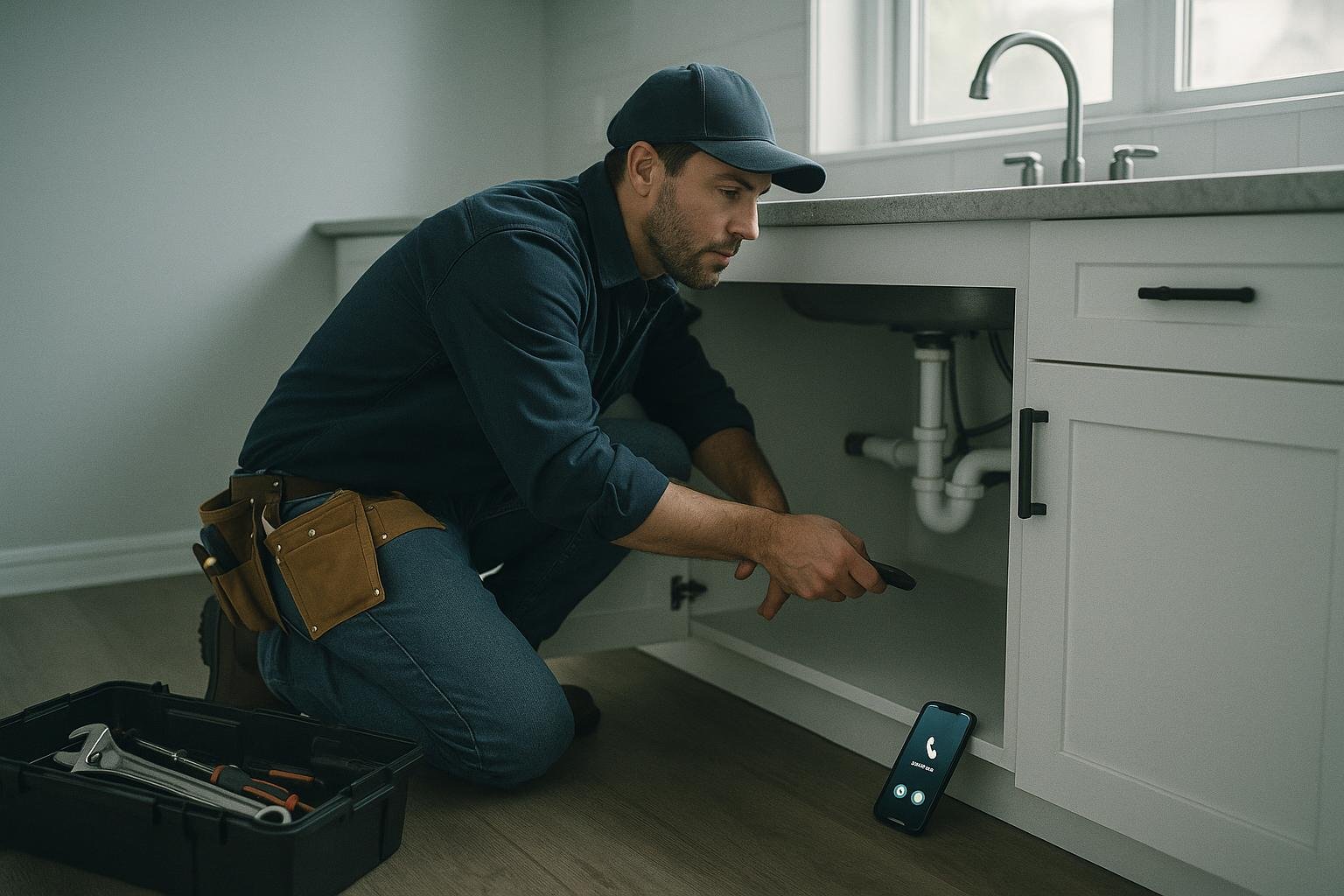
The Plumber's Unfair Advantage: AI Answering for Emergency Calls
An ai plumbing answering service answers every call the moment it comes in — burst pipes at 2 AM, backed-up drains on a Sunday, no hot water the morning of a big family event — and qualifies the urgency, captures the caller's details, and books the job before they even think about dialing your competitor. No voicemail. No missed revenue.
- 62% of calls to small plumbing businesses go unanswered — the caller immediately dials the next result.
- An AI answering service costs $300–$500/month versus $30,000–$60,000/year for a full-time receptionist.
- Emergency plumbing callers decide within seconds. The first company that answers wins the job.
- The call ends with a structured handoff — caller name, address, problem, urgency — pushed straight to your team.
The Call You Missed at 11 PM
Picture this. It's a Tuesday night, 11:07 PM. A homeowner in your service area just walked into their basement and found two inches of standing water creeping toward the furnace. Pipe burst somewhere behind the drywall. They're panicking. They grab their phone and search "emergency plumber near me."
Your business comes up first. They tap your number.
It rings. And rings. Then voicemail.
They hang up before the beep. They don't leave a message — nobody does anymore. They scroll down to the next result and try again. That plumber answers. That plumber gets the job. And depending on the damage, we're talking a $2,000–$8,000 emergency service call that just walked out the door because your phone went to voicemail at 11 PM.
Sound familiar? I hear this story constantly from plumbers who reach out to us. Not because they're bad at what they do — they're exceptional at their trade. The problem is that the phone doesn't care how good your work is. It only cares whether someone picks up.
What That Missed Call Actually Costs You
Here's the part most people underestimate. It's not just one job. It's the relationship that job would have started.
Emergency plumbing calls have a conversion rate that most service businesses would kill for — when you answer, you almost always book the job. The caller is not shopping around for price. They have water coming through their ceiling. They need someone now, and "now" means whoever picks up the phone.
According to the Bureau of Labor Statistics, hiring a full-time receptionist runs $30,000–$60,000 per year when you factor in salary, benefits, and payroll taxes. And a full-time receptionist still doesn't cover nights, weekends, or holidays — which is exactly when your most urgent calls come in.
Commercial plumbing raises the stakes further. A restaurant with a blocked drain at 6 AM can't open for the breakfast rush. An office building with no water pressure on a Monday morning has 200 frustrated people and a facilities manager who needs this fixed right now. Those callers aren't just one job. They're accounts. Miss the call, and you're not just losing today's revenue — you're handing that account to a competitor who answered.
Why It Keeps Happening
It's not laziness. Every plumber I've talked to wants to answer every call. The reality is that the calls come at the worst possible moments.
You're under a sink. You're driving between jobs. Your one office person is handling a billing dispute. It's 2 AM and your phone is on silent because if you don't sleep, you can't work. The call volume during a storm event or a cold snap is five times your normal rate — and your normal rate already stretches you thin.
Traditional solutions don't actually solve it. An answering service staffed by humans costs nearly as much as a part-time employee, can't qualify a plumbing emergency, and usually just takes a message that sits until morning. An IVR tree frustrates callers who are already stressed. Hiring another person to answer phones only works when that person isn't on break, out sick, or dealing with two other callers at once.
The mechanism of the problem is simple: the demand is unpredictable and the supply of human attention is finite. That mismatch is where jobs get lost.
How Does an AI Plumbing Answering Service Actually Work?
An ai plumbing answering service answers every inbound call in under one second, 24 hours a day, 365 days a year — with a natural-sounding AI voice trained on your business information. It's not a phone tree. It's a conversation.
Here's what the call actually looks like from the caller's side:
They call your number. The AI picks up immediately with your custom greeting — "Thanks for calling [Your Business], I'm here to help." It asks what's going on. The caller explains their situation. The AI qualifies the issue in real time: Is this an emergency or a scheduled service request? What's the address? What's the nature of the problem? Has the water been shut off?
By the end of that call — which typically runs two to four minutes — the system has captured the caller's name, phone number, address, problem description, and urgency level. That data gets pushed out as structured information to your team, not as a voicemail someone has to listen to and transcribe. If you've connected a scheduling tool like Cal.com, it can book the appointment during the call itself. The caller also gets an automatic text and email recap confirming what was discussed and what happens next.
That last part matters more than people realize. The confirmation loop — the automatic text and email after every call — kills the "I thought someone was coming" ambiguity that leads to angry callbacks and negative reviews. The customer has it in writing. Your team has the structured data. Nothing falls through the cracks.
You can explore the full capability set on CallagentAI's features page — the call transfer, multi-language support, and real-time transcription are all part of the same package.
Before and After: The Numbers Side by Side
| Scenario | Without AI Answering | With AI Answering |
|---|---|---|
| 11 PM emergency call | Voicemail. Caller hangs up. | Answered in <1 second. Job qualified and captured. |
| Storm event call spike | Busy signals. Calls overflow to voicemail. | Unlimited concurrent calls. Every caller answered. |
| Caller information | Voicemail someone has to manually listen to and re-enter. | Structured data pushed to your team automatically. |
| Customer confirmation | "Did anyone call me back?" Ambiguity, angry follow-ups. | Automatic text + email recap. Customer has it in writing. |
| Annual cost | $30,000–$60,000 for a human receptionist (still no nights/weekends) | $300–$500/month. 24/7/365. No sick days. |
Honestly, the cost comparison is almost a secondary argument. The primary one is that the human receptionist doesn't answer at 11 PM, and that's exactly when the highest-value calls come in.
Does an AI Plumbing Answering Service Work With My Existing Tools?
A good ai plumbing answering service doesn't require you to rip out your existing workflow. It plugs into it.
Here's how CallagentAI handles the handoff. After every call, the system pushes structured data — caller name, phone, address, problem description, urgency level — through a webhook. That data goes wherever you point it. If your team uses a field service platform, you can wire that webhook through Zapier or Make and have the job record created automatically without anyone typing it in. Your dispatcher sees it immediately. The job is in the system before you've even finished the next service call you're on.
Native integrations include Cal.com for live appointment booking during the call itself, and Zoho CRM for automatic lead and contact creation. You can see the full integration picture at callagentai.com/integrations.
For appointment-based work — drain cleanings, water heater installs, scheduled inspections — the AI can book directly into your calendar during the call. The customer picks a time, gets a confirmation text, and the appointment is locked. No back-and-forth. No "I'll have someone call you to schedule."
The voice-AI market is growing at 45.8% CAGR according to current industry research, which means the tools are getting better fast. But the core value for a plumbing business isn't the technology — it's the answer rate. Every call answered is a job that doesn't go to the next company on Google.
Pricing starts well below what you'd pay for even part-time phone coverage. See the current plans at callagentai.com/pricing — there's a free trial so you can test it against real calls before committing to anything.
I'll be blunt: if you're running a plumbing business and relying on voicemail after 5 PM, you're donating jobs to competitors. The ai plumbing answering service model exists precisely because the gap between "when customers call" and "when humans are available to answer" is widest in the trades. Plumbing is at the top of that list — emergencies don't schedule themselves around business hours.
The unfair advantage isn't complicated. It's just answering every time. Want to see what that looks like for your business? Try a live demo and run a real call through it.
Frequently Asked Questions
What is an AI plumbing answering service?
An AI plumbing answering service is an automated phone system that uses conversational AI to answer every inbound call immediately, qualify the issue (emergency vs. routine), capture structured caller information, and trigger follow-up actions like booking appointments or pushing data to your dispatch team — all without a human operator picking up the phone.
Will callers know they're talking to an AI?
Modern AI voice agents use natural-sounding voices with conversational pacing that most callers find indistinguishable from a receptionist. The goal isn't to deceive — it's to handle the call effectively. Emergency plumbing callers care about being heard and helped fast, not about whether a human or AI took the message. If a situation requires a human, the AI transfers the call.
How does the call information get to my dispatcher?
After every call, CallagentAI pushes structured data — caller name, phone number, address, problem description, and urgency level — through a webhook to your team. If you run field service software, you can connect that webhook via Zapier or Make to auto-create the job record. No one has to listen to a voicemail and retype anything manually.
Can it handle true plumbing emergencies — burst pipes, flooding?
Yes. The AI is trained on your business's specific procedures, including how to classify and respond to different urgency levels. It can immediately route high-urgency calls to an on-call number via call transfer, while capturing all the critical details. For residential emergencies like burst pipes, it also advises the caller to shut off the main water supply while help is arranged.
How much does an AI plumbing answering service cost?
CallagentAI plans run approximately $300–$500 per month depending on call volume and features — compared to $30,000–$60,000 annually for a human receptionist who still won't cover nights and weekends. There's a free trial available so you can test it with real inbound calls before committing to a paid plan. See current pricing at callagentai.com/pricing.
Does it work after hours and on weekends?
That's the entire point. An AI plumbing answering service runs 24 hours a day, 7 days a week, 365 days a year — with no overtime, no sick days, no holidays. It handles unlimited concurrent calls, so even during a storm event when your lines would normally be overwhelmed with simultaneous inbound calls, every caller gets answered immediately.