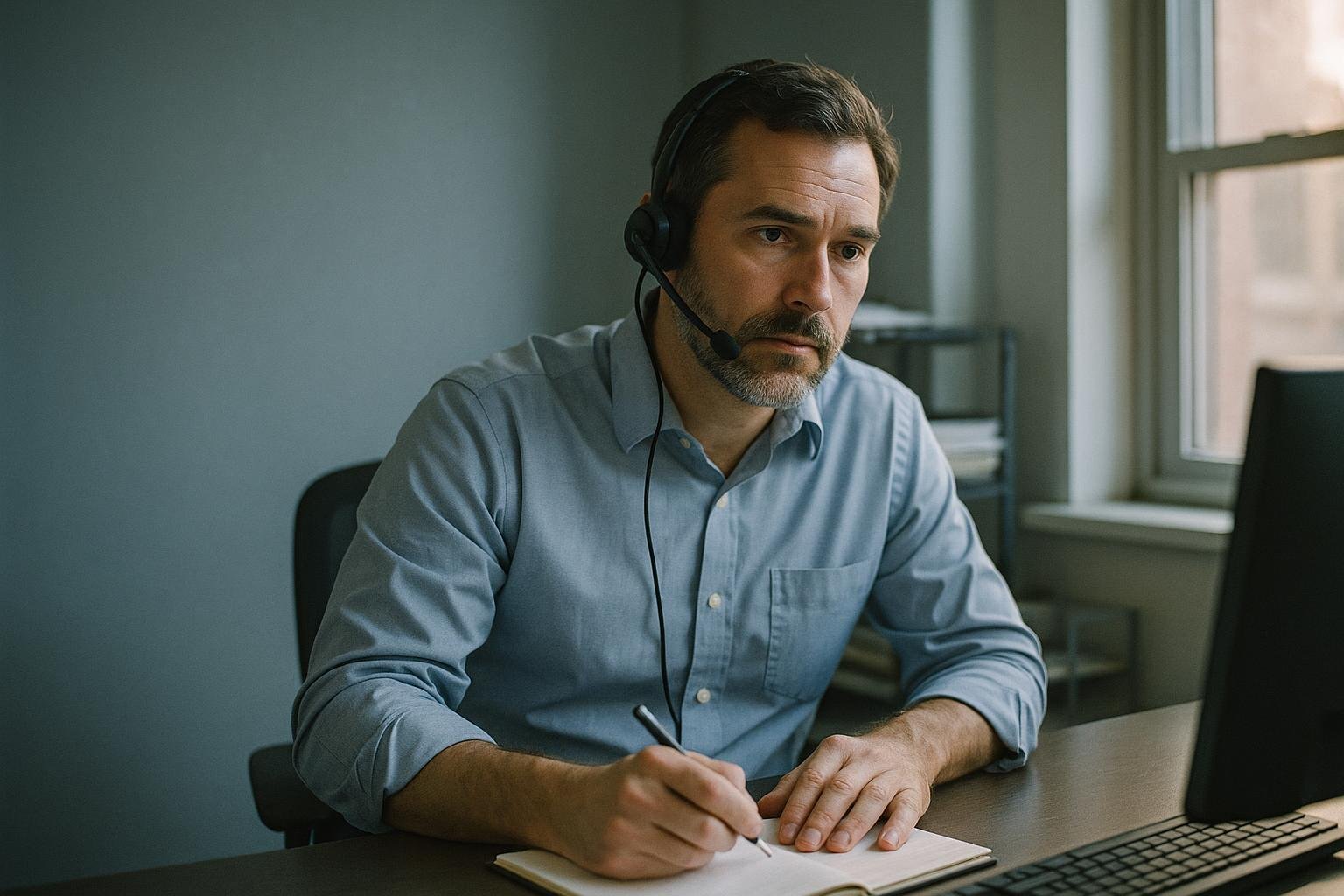
How AI Handles Angry Callers Better Than You'd Expect
I get this question all the time: "Can AI handle angry customers phone calls without making things worse?" It's a fair concern. And honestly, when I was building CallagentAI, I wasn't 100% sure myself. What I've seen since launching has surprised me — in the best possible way. The short answer is yes, AI can handle angry customers on the phone. But the why is more interesting than you might think.
Let me walk you through what actually happens when a frustrated caller hits an AI voice agent — and why, in many cases, it goes better than when a human picks up.
The Problem With Human Reactions
Here's something nobody talks about enough: humans are bad at receiving anger. Not because they're incompetent — but because we're wired to mirror emotional states. When someone yells at you, your body responds. Cortisol spikes. Your voice tightens. You get defensive, even when you're trying not to.
I've talked to dozens of small business owners — a dental office manager in Phoenix, a plumbing company owner in Ohio, a salon owner in Nashville — and they all say the same thing. Their front desk staff dread those calls. The aggressive ones. The ones where someone is already furious before the conversation even starts.
That dread leads to problems. Staff put calls on hold too long trying to compose themselves. They match the caller's energy without meaning to. Sometimes they hang up. Sometimes they say something they shouldn't. And then the business loses not just the call, but the customer — and potentially gets a scathing Google review to boot.
This is exactly the gap where AI performs better than most people expect.
How AI Handle Angry Customers Phone Calls Differently
The fundamental advantage AI has in these situations isn't intelligence. It's consistency. An AI voice agent doesn't have a bad morning. It doesn't have unresolved stress from the previous call. It doesn't feel personally attacked when someone swears at it.
Every single call gets the same calm, measured tone. Every time. That consistency is genuinely powerful when you're dealing with an upset caller.
Here's what I've observed across thousands of calls processed through CallagentAI:
- Angry callers often de-escalate on their own when they're met with patience instead of defensiveness. The AI doesn't react to emotional bait — it just keeps addressing the issue.
- The AI never interrupts. One of the biggest triggers for escalating anger is feeling unheard. Our agents wait, listen fully, then respond. That alone changes the dynamic.
- No judgment in the voice. Human agents — even well-trained ones — sometimes let a hint of irritation or condescension slip through. The AI doesn't.
- It focuses on solutions immediately. Instead of explaining policies defensively, the AI pivots to what it can do for the caller.
Does AI handle angry customers on the phone perfectly every time? No. But neither does a human. The difference is the AI's floor is much higher — the worst-case AI response is still calm and professional.
Real Scenarios Where AI Wins
I want to give you concrete examples here, not just theory.
The After-Hours Complaint Call
A customer calls a dental office at 8 PM furious about a billing error. Without AI, that call goes to voicemail — which makes them angrier. With CallagentAI, they're greeted immediately, acknowledged, and offered options: leave a message for the billing team with a callback guarantee, or book an appointment to resolve it in person. The AI that can handle angry customers on the phone at 8 PM is worth more than you'd think.
The Service Complaint
An HVAC customer calls screaming because their unit still isn't working three days after a repair visit. A stressed human agent might get defensive about the technician's work. The AI? It apologizes for the inconvenience without admitting liability, confirms the service details, and books an urgent follow-up appointment — all in under two minutes. Check out our features page to see how appointment booking works in real time during calls.
The Repeat Caller
Someone who's called three times about the same unresolved issue. By call three, they're past frustrated — they're hostile. The AI doesn't carry the baggage of the previous calls. It treats each interaction fresh, which paradoxically helps defuse the situation because the caller doesn't feel like they're being treated as a problem.
Common Objections — Answered
Real talk: I hear the same pushback on this topic over and over. Let me address the big ones directly.
"Angry customers want to talk to a real person."
Sometimes, yes. And our AI is built to recognize that. When a caller explicitly asks for a human, or when the situation clearly requires human judgment, the AI transfers the call. But here's what the data shows: most angry callers don't actually want a person — they want their problem solved now. If the AI can do that, most callers accept it.
"What if the AI says the wrong thing?"
This is why setup matters. CallagentAI agents are trained on your specific business — your policies, your FAQs, your escalation procedures. The AI isn't improvising. It's working from a script of information you provided. That guardrail is actually safer than a human who might go off-script under pressure.
"Customers will feel disrespected talking to a bot."
I'll be blunt here: a customer who reaches a voicemail at 9 PM feels more disrespected than one who reaches an AI that actually helps them. According to research from Harvard Business Review, customers value effort reduction above almost everything else in a service interaction. The AI reducing their effort — even if it's not human — matters more than the medium.
"AI can't handle complex emotional situations."
You're right that AI can't replicate human empathy perfectly. But it can do something almost as valuable: it can be reliably not hostile. In many complex emotional situations, what people need first is to not have their anger amplified. AI nails that consistently.
When AI Should Hand Off to a Human
I'm not here to oversell this. There are situations where AI handle angry customers phone calls reaches its limit and a human needs to step in. Our system is built to recognize these:
- The caller explicitly and repeatedly demands a human agent
- The issue involves legal threats or formal complaints
- The situation requires account-level access or real-time decisions beyond what the AI is authorized to make
- The caller becomes abusive to the point where no resolution is possible without human authority
In all these cases, CallagentAI transfers the call — along with a real-time summary of what's already been discussed, so the human agent isn't starting from zero. That handoff quality matters. Check our integrations page to see how call data flows into your CRM and team tools when a transfer happens.
A study from McKinsey found that customers who have a smooth escalation experience — where the new agent already knows their history — rate the overall interaction significantly higher, even after a poor start. That context transfer is something most small businesses completely miss.
The Bottom Line on AI and Angry Callers
Here's what I want you to take away from this. The question isn't whether AI handle angry customers phone calls as well as a perfectly trained, emotionally regulated, always-on-their-game human agent. The question is whether AI handles them better than what your business is actually doing right now.
For most small businesses? That means voicemails getting ignored. Stressed staff escalating tense calls. After-hours calls going completely unanswered. Those outcomes are worse than what a well-configured AI agent delivers — every single time.
62% of calls to small businesses go unanswered. Every one of those could be an angry customer who needed help and instead got silence. That silence is the real service failure.
If you want to see how AI handles these calls in practice — not just read about it — I'd encourage you to visit our demo page and test it yourself. Make a call. Try to trip it up. I'm genuinely confident in what you'll see.
Because when AI handle angry customers phone calls correctly — with patience, consistency, and immediate problem-solving — it doesn't just prevent a bad experience. It sometimes turns an angry caller into a loyal one.
And that's something worth paying attention to.