
How Call Analytics Help You Understand What Customers Really Want
If you're not using ai call analytics customer insights to understand your callers, you're making business decisions in the dark. I built CallagentAI specifically because I kept seeing small business owners guess what their customers wanted — when the answer was sitting right there in their phone calls, completely untapped. Every conversation a customer has with your business is data. And until recently, most of that data just evaporated the moment the call ended.
That changes when you put AI on the line.
Why Phone Calls Are a Goldmine You're Ignoring
Here's a number that still blows my mind: 62% of calls to small businesses go unanswered. Not only are those businesses losing the call — they're losing the intelligence inside it. The customer who called asking about weekend availability, the one who wanted to know if you offer financing, the person who hung up because they waited too long — all of that is signal. Real, actionable signal about what your market actually needs.
Email open rates tell you something. Website clicks tell you something. But a phone call? That's someone who cared enough to pick up the phone and dial. That's about as high-intent as it gets. The things people say on calls — the exact words they use, the questions they repeat, the frustrations they express — that's your customer research department, and most businesses aren't listening.
Traditional call logs just show you a timestamp and a duration. That's not insight. That's trivia. What you actually need to know is what people are calling about, how those topics shift over time, which questions come up again and again, and where callers are dropping off or getting frustrated. That's what ai call analytics customer insights are designed to surface.
What AI Call Analytics Customer Insights Actually Reveal
When I talk to business owners who've just started using our analytics dashboard, the reaction is almost always the same. They say something like, "I had no idea that's what people were calling about." Not in a bad way — just surprised. The patterns that emerge from real call data are often completely different from what you'd assume.
So what does ai call analytics customer insights actually show you? A few things that matter a lot:
- Top call topics — What are the three things people call you about most? Is it pricing? Scheduling? A specific service or product? Knowing this lets you restructure your website, train your team, and update your AI agent's responses to handle these better.
- Peak call times — When are most calls coming in? If you've got a spike every Monday at 9am and nobody's answering, that's a fixable problem. You now know exactly where to focus.
- Missed call analysis — Which calls went unanswered, and what did those callers want? This one hurts to look at the first time, but it's incredibly valuable.
- Sentiment patterns — Are callers frustrated? Confused? Satisfied? AI transcription picks up on tone and language in ways that help you identify friction points in your customer experience.
- Conversion indicators — Which call types turn into booked appointments or captured leads? Which ones don't? That gap is where revenue is leaking.
This is the kind of intelligence that used to cost enterprise companies tens of thousands of dollars to collect through market research. Now it's built into every call your AI agent handles.
Inside the CallagentAI Analytics Dashboard
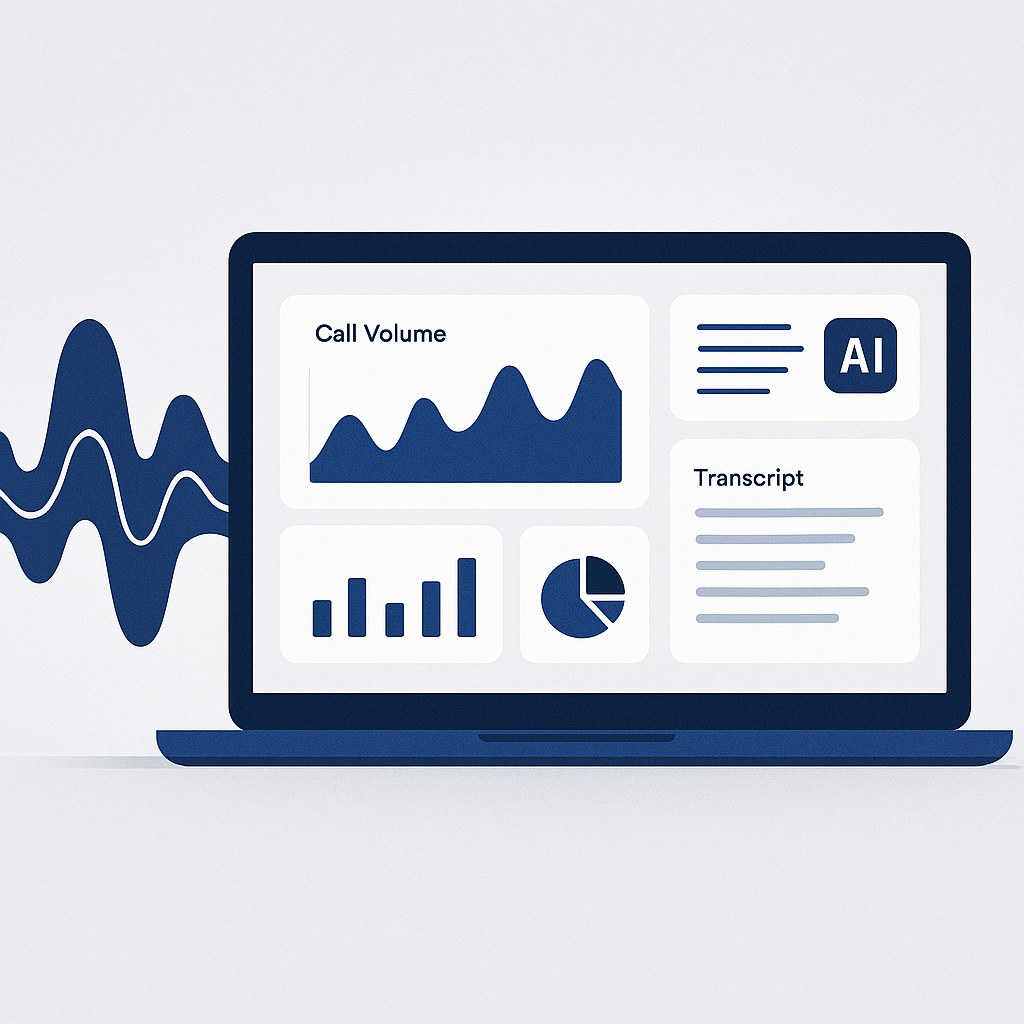
I want to be specific here, because vague descriptions don't help anyone. Our analytics dashboard gives you a real-time view of your call activity with a few things I think are genuinely useful.
Every call gets a full transcript. Not a summary — the actual conversation, word for word. That means you can search across all your calls for any term. Want to know how often people ask about your return policy? Search "return" and every call where that word came up is right there. That's ai call analytics customer insights working at a granular level that a human receptionist could never provide — not because they're bad at their job, but because no one can transcribe, tag, and search thousands of calls simultaneously.
You also get automated call summaries. After each call, the AI generates a short summary of what was discussed and what action was taken. Did the caller book an appointment? Get their question answered? Request a callback? That data flows into your dashboard and, if you've connected it, straight into your CRM. Check out our integrations page to see how this connects with tools like Zoho and Cal.com.
And then there's the volume tracking — call counts by day, week, and month. This sounds basic, but it's surprisingly powerful when you look at it over time. I've had customers realize their call volume doubles every spring, which they kind of knew anecdotally but had never quantified. Now they can staff accordingly, or just make sure their AI agent is configured to handle the surge.
Call Recording and Playback
Beyond transcripts, you can listen back to any call. This is huge for quality control and training. If you want to hire a human for complex calls and train them on real examples of what customers say, you've now got a library to pull from. It also helps me personally — I listen to random calls from our demo users pretty regularly because it keeps me honest about what the product is actually doing in the real world.
Multi-Agent Analytics
If you've set up more than one AI agent — say, one for general inquiries and one for after-hours emergencies — you can track their performance separately. This matters because the patterns are often totally different. Your after-hours callers tend to have more urgent, specific needs. Knowing that helps you configure each agent more precisely.
Real-World Examples: What Our Customers Found Out
Real talk: the best way I can explain the value of ai call analytics customer insights is through actual stories. I won't name specific businesses, but these are patterns I've seen firsthand.
A dental office using CallagentAI discovered that nearly 40% of their incoming calls were about insurance — specifically, whether they accepted certain plans. That question wasn't prominently answered anywhere on their website. Once they knew that, they updated their site, trained their AI agent to lead with insurance info, and their call-to-appointment conversion rate went up noticeably. The ai call analytics customer insights didn't just surface the data — they pointed directly at the fix.
An HVAC company found that most of their emergency calls came in between 10pm and 2am on weeknights. They'd assumed weekends were their busiest after-hours period. Wrong. They adjusted their AI agent's after-hours routing and made sure emergency dispatch was properly configured for those hours. Before analytics, they were guessing. After, they were operating on actual evidence.
A law firm noticed that a significant portion of callers were asking questions that indicated they weren't actually a good fit for the firm's practice areas. Their AI agent was spending time on calls that would never convert. They updated the screening questions and added clearer messaging about their specialty. Fewer wasted calls, higher quality leads.
How to Use AI Call Analytics Customer Insights to Grow
Okay, so you've got the data. Now what? This is where a lot of businesses get stuck — they have insights but don't translate them into action. Here's how I recommend approaching it.
Start with your top three call topics. Whatever your callers are asking about most, make sure your AI agent answers those questions brilliantly. Update the prompt, add more detail, make the response clearer. Then check if those same questions are answered well on your website. If people are calling to ask something they should be able to find online, that's a content gap worth closing.
Look at your missed calls with fresh eyes. Every missed call in your analytics is a customer who tried to reach you and couldn't. What were they calling about? If it was something your AI could handle, make sure your AI is actually configured to cover those hours. If it was something complex, think about whether your call transfer rules need adjusting.
Track changes over time. The real power of ai call analytics customer insights compounds over months. Month one, you see the baseline. Month three, you start seeing whether your changes made a difference. Did the "what are your hours?" calls drop after you updated your Google Business profile? The data will tell you.
Feed insights back into your marketing. If your analytics show that callers keep asking about a specific service you offer, that's a signal to invest more in promoting it. If they're asking about something you don't offer, that's a product development signal. Your calls are a direct line to market demand — you should absolutely use that to shape your business decisions.
Getting Started with Call Analytics
Honestly, the hardest part is just getting started. Once you've got ai call analytics customer insights flowing in, you'll wonder how you made decisions without them. Setup takes less than ten minutes — you pick your AI voice, connect your phone number, and the dashboard starts populating with data from your very first call.
If you want to see what the dashboard actually looks like before committing, you can check out our demo page and get a feel for it. And if you're curious about what it costs, we've built it to be accessible — head to our pricing page to see the options. It's a fraction of what you'd spend on even a part-time receptionist, and unlike a receptionist, it never stops collecting data on your behalf.
The bottom line? Your customers are already telling you exactly what they want. They're doing it every time they call. AI call analytics customer insights just make sure you're actually hearing it — and that you can act on it systematically, not just occasionally when you happen to be in the room for the right call.
Stop guessing. Start listening. The data's already there.