24/7 or Bust: Why Commercial HVAC Contractors Can't Afford Downtime
A 24/7 HVAC answering service is the difference between keeping a commercial facilities contract and losing it to the contractor who picked up the phone at 2 AM. When a facilities manager calls after hours and hits voicemail, they don't wait until morning — they call the next number on the list. By 6 AM, that job is gone. So is the relationship.
- Facilities managers expect a live response at any hour — voicemail is a contract risk, not an inconvenience.
- A single missed emergency call can trigger a contract review on accounts worth $600K–$2M annually.
- A 24/7 HVAC answering service qualifies the call in real time, captures structured data, and closes the loop with an automatic confirmation to the caller.
- The handoff is automated — no dispatcher has to listen to a voicemail at 3 AM to know what happened.
The 2 AM Call That Ends Contracts
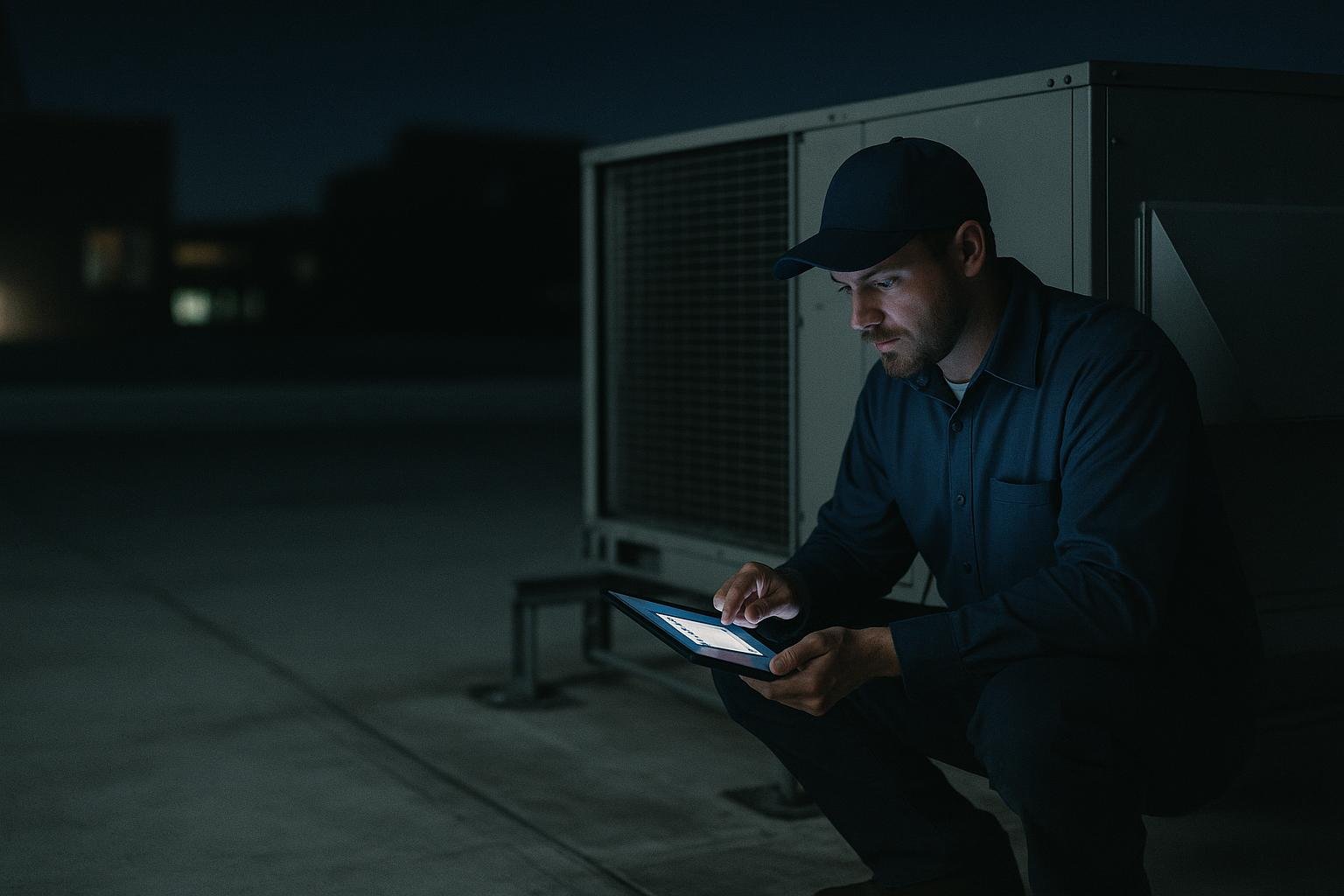
Picture this. It's 2:17 AM on a Tuesday in February. The HVAC system in a downtown office complex just failed — no heat, building temperature dropping, and the facilities manager for a 12-property portfolio is standing in the lobby watching the thermostat read 58°F.
He pulls out his phone. He calls you — his current HVAC contractor.
Voicemail.
He calls the backup number. Voicemail again. He leaves a message, but honestly, he's already scrolling to the next contractor in his contacts. By 6 AM, when your on-call tech finally checks his phone, a competitor has already been dispatched. And the facilities manager — who manages contracts worth north of $800K annually — is now wondering why he's still using you.
That's not a missed lead. That's a contract on the chopping block.
What a Missed Call Actually Costs a Commercial HVAC Contractor
Commercial HVAC contracts aren't like residential service calls. A residential customer who hits voicemail at midnight will probably call back in the morning. They're frustrated, but they're not running a building with SLA obligations baked into their lease agreements.
A facilities manager is different. He has responsibilities to building owners, tenants, and sometimes regulatory bodies. When the mechanical systems fail, he needs a documented response — and fast. If your company can't provide that, he'll find one that can. And he won't tell you he's shopping around. You'll find out when the renewal conversation never happens.
Here's what this actually looks like in dollar terms:
| Scenario | Immediate Cost | Long-Term Risk |
|---|---|---|
| Missed emergency call, voicemail | Lost emergency dispatch fee ($500–$2,000) | Contract review triggered |
| Facilities manager switches contractors | 0 (you don't even know yet) | $600K–$2M annual contract gone |
| Late response, issue resolved by competitor | Competitor earns the emergency revenue | Competitor now has the relationship |
| 24/7 HVAC answering service deployed | ~$300–$500/month | Account retained, documented response on file |
The math isn't complicated. One retained commercial account pays for years of AI call coverage. The question isn't whether you can afford a 24/7 HVAC answering service — it's whether you can afford not to have one.
Why Does This Keep Happening?
I talk to commercial HVAC contractors all the time, and none of them intend to miss calls. They have on-call systems. They have cell phones. They have instructions for their team. But here's the reality:
On-call rotation is exhausting. Technicians who've worked a 10-hour day in a mechanical room don't always hear their phones at 2 AM. Or they hear it, see an unknown number, and roll over. Or they answer, and the caller starts explaining a complex situation that the tech doesn't have the context to qualify — so he says "I'll have someone call you in the morning" and the FM is done with you before sunrise.
The problem isn't motivation. It's system design. A human on-call rotation was never built to deliver consistent, documented, always-on response. It's a patch over a gap, and commercial clients — especially facilities managers with multi-property portfolios — can feel that gap every time they reach for their phone after hours.
Meanwhile, according to BLS data, a full-time receptionist costs $35,000–$48,000 per year in salary alone — and they go home at 5 PM. You can't staff 24/7 coverage with headcount at a reasonable cost. That's just the math.
How Does a 24/7 HVAC Answering Service Actually Work?
A 24/7 HVAC answering service powered by AI answers every inbound call — day, night, weekends, holidays — in under a second. No hold music. No voicemail. A live voice that knows your business, your service area, your emergency protocols, and your typical call types.
When a facilities manager calls at 2 AM, here's what actually happens:
- The call is answered immediately — with your company name, your custom greeting, your tone.
- The issue is qualified in real time — is this a complete system failure or a comfort complaint? One building or multiple sites? Is the building occupied right now?
- Caller details are captured — name, callback number, site address, urgency level, description of the fault.
- The structured data is pushed to your team — through a webhook that can connect to whatever dispatch system or CRM you already run, via Zapier or Make if needed.
- The caller gets a confirmation — an automatic text and email summary of what was discussed, what happens next, and who to expect a call from. The FM has documentation. You have documentation. Nobody's playing phone tag at 7 AM trying to remember what was said.
That last step — the confirmation loop — is the one most people underestimate. A facilities manager who gets a text at 2:19 AM saying "We received your call about the heating failure at 400 Commerce Drive. Our team has been notified and will contact you within 30 minutes" is not calling your competitor. He's waiting for your call. And he's got proof of your response time if anyone asks.
You can explore the full feature set on CallagentAI's features page — but the core of it is this: answer, qualify, capture, hand off, confirm. That's the loop that keeps commercial accounts.
The Automated Handoff: Call to Structured Data
Here's where a 24/7 HVAC answering service built on AI beats a traditional answering service every time. A human answering service takes a message. You get a voicemail or an email with a paragraph of notes that someone still has to read, interpret, and re-enter into your system.
With AI, the call produces structured fields — caller name, site address, problem description, urgency level, callback number. That data gets pushed out by webhook the moment the call ends. If you run a dispatch tool, your Zapier or Make automation picks it up and creates the job record automatically. Your dispatcher doesn't listen to a voicemail at 6 AM. They open their dashboard and the job is already there, categorized and ready to assign.
No manual re-entry. No "I thought someone told dispatch about this." No 45-minute delay while a groggy on-call manager pieces together what the caller actually said.
For the specifics of how the data handoff works — including webhook configuration and CRM integration with Zoho — the CallagentAI integrations page has the full picture.
I'll be direct: this isn't magic. It's a well-designed data path. The AI qualifies the call, structures the output, and your systems receive it. The value is that a human doesn't have to touch it at 2 AM to make it happen. That's the whole point.
Before and After: What Changes on Day One
Honestly, the shift is less dramatic than people expect — and more durable. You don't rip out your existing phone system. You don't retrain your team. CallagentAI routes inbound calls through the AI agent, and your dispatcher's morning looks different in one specific way: instead of a stack of voicemails, they have a structured list of overnight contacts with everything they need to act on each one.
Setup takes less than a day. You configure your greeting, your service area, your emergency escalation protocol, and your business hours. The AI learns your business from the information you provide. From that point, every call — whether it's 11 AM on a Monday or 3 AM on a Sunday in January — gets answered, qualified, documented, and handed off the same way.
According to McKinsey research on AI automation, businesses that deploy AI for customer-facing workflows see average response time improvements of 60-80% for after-hours interactions. For commercial HVAC, where response time is often written into service agreements, that number matters.
And on cost — a fully staffed 24/7 human answering service runs $1,500–$3,000 per month at minimum. A 24/7 HVAC answering service powered by AI through CallagentAI's pricing tiers starts at a fraction of that. The commercial account you keep pays for the service many times over in the first month alone.
Frequently Asked Questions
What is a 24/7 HVAC answering service?
A 24/7 HVAC answering service is an always-on call handling system — AI-powered or staffed — that answers inbound calls at any hour, qualifies the issue, captures caller details, and routes the information to your dispatch team. It ensures no emergency call hits voicemail, protecting both service revenue and long-term commercial contracts.
How much does a 24/7 HVAC answering service cost?
Traditional human answering services run $1,500–$3,000 per month for true 24/7 coverage. AI-powered services like CallagentAI cost significantly less — typically under $500 per month depending on call volume — while delivering faster response times, structured call data, and automatic customer confirmations that human services rarely provide.
Can a 24/7 HVAC answering service integrate with my dispatch software?
Yes — through webhooks. When a call ends, the AI pushes structured call data (caller name, site, urgency, fault description) to any system you already use via a webhook. If you run Jobber, ServiceTitan, or similar tools, a Zapier or Make automation can create the job record automatically, so your dispatcher sees it immediately without manual re-entry.
Will a facilities manager accept an AI-answered call?
In practice, yes — especially when the AI answers in under a second, uses natural language, qualifies the issue correctly, and sends an immediate text confirmation. What a facilities manager cannot accept is voicemail. An AI that acknowledges the call, captures the problem, and confirms a response timeline is far preferable to a message that sits unread until morning.
What happens on the most urgent calls — building failures at 2 AM?
The AI qualifies urgency in real time. For calls flagged as emergencies — complete system failure, occupied buildings, safety risk — the system can trigger an immediate call transfer to your on-call technician or dispatcher. That transfer happens based on the criteria you define, so genuinely urgent calls escalate while routine inquiries are captured and handled the next morning.
How quickly can I set up a 24/7 HVAC answering service?
With CallagentAI, setup typically takes less than a day. You provide your business details, service area, emergency protocols, and greeting. The AI is trained on that information and begins answering calls immediately. No hardware changes, no lengthy onboarding, no technical expertise required — just configure and go live.
Look, commercial HVAC is a relationship business. The facilities manager who calls you at 2 AM isn't testing your response time for fun. He's in a building with a problem that has real consequences if it isn't addressed. When you answer that call — every single time, regardless of the hour — you're not just solving the immediate issue. You're proving you're the contractor he doesn't have to worry about.
That's what keeps a $1.2M facilities contract from going to bid next renewal cycle. Not your equipment. Not your pricing. The fact that you picked up.
If you want to see how a 24/7 HVAC answering service handles a live call — including how it qualifies emergencies and what the confirmation text looks like — try the CallagentAI demo and run a test call yourself. Takes five minutes. You'll see exactly what your facilities manager would experience at 2 AM.